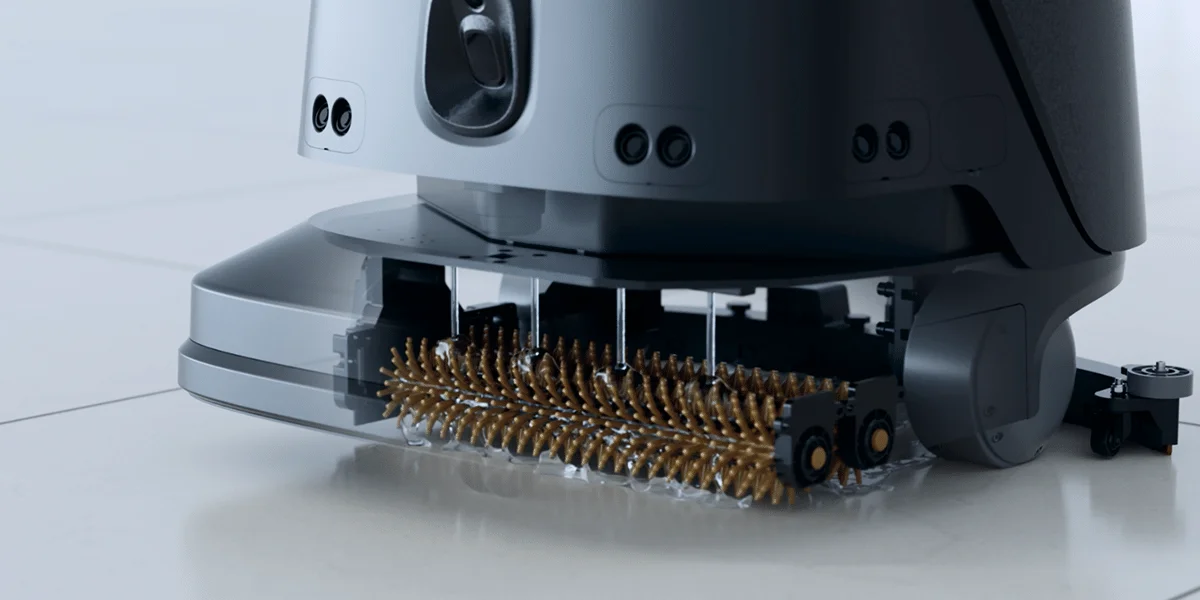
A scrubber-dryer performs three work steps in a single pass. It applies water and detergent to the floor, breaks the dirt loose mechanically with a rotating roller or disc brush, then lifts the dirty solution with a rubber squeegee and draws it into the waste water tank. What remains behind the machine is a walkable floor, not mop water drying in place. That is the whole point of the class: the dirt is removed rather than redistributed. In its manually guided form — a machine like the SH1, pushed by one person — the principle is over half a century old and unchanged.
Everything else in the class scales with two figures. The first is working width, which decides how much floor one pass covers: 440 mm on the guided SH1, 450 mm on the compact L4, 510 mm on the industrial L50. The second is tank volume, which decides how long the machine runs before someone has to intervene: 4 litres of fresh water on the SH1, 15 on the CC1, 38 on the L4, 55 on the L50. A small tank on a large area does not mean slow cleaning, it means frequent refill stops — which is a staffing question, not a machine question.
And the boundaries matter as much as the capability. A scrubber-dryer is a hard-floor machine. For the CC1 our product data names the approved surfaces explicitly — terrazzo, marble, tiles, epoxy resin, sandstone and artificial stone — with short-pile carpet handled in vacuum mode, dry. Carpet, deep textile and heavily structured surfaces are a different machine class, and no acquisition model fixes a wrong class. Which class fits which floor is the question our scrubber-dryer guide answers before this article becomes relevant at all.