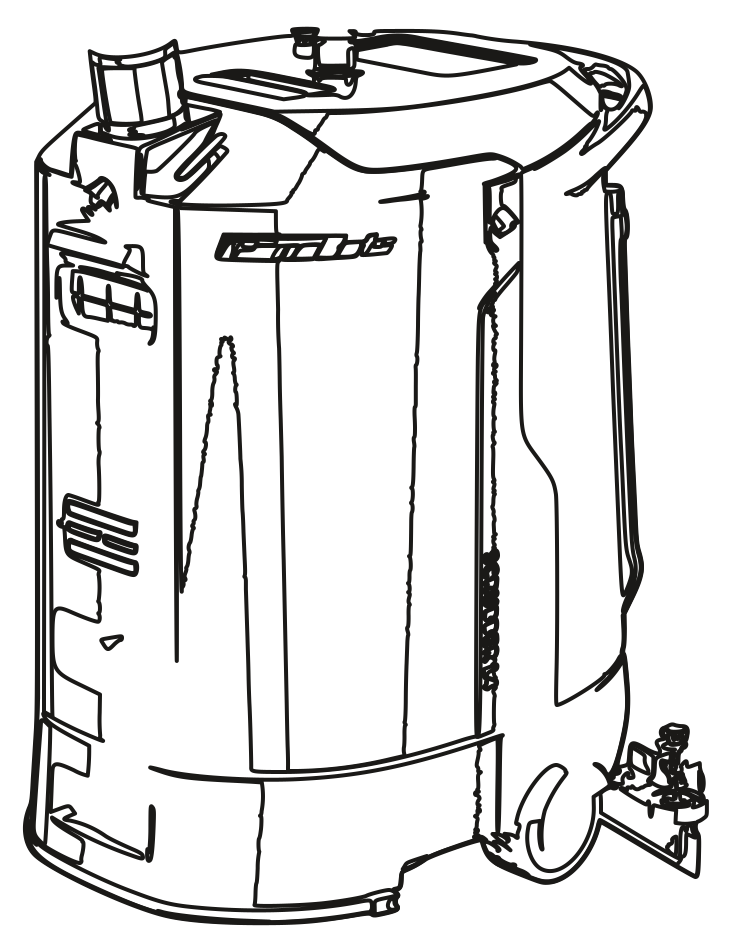
Mechanically, a scrubber is four assemblies working in sequence: a fresh water tank that meters water and detergent onto the surface; a rotating brush — disc or roller — that loosens the dirt with a defined contact pressure; a squeegee directly behind it that pulls the dirty water back up; and a recovery tank that holds it. Pudu's official manual for the CC1 calls the two tanks "solution tank" and "waste water tank", 15 litres each. Contact pressure is the number that decides how much cleaning actually happens: 18 kg on the L3, 20 kg on the L4, 25 kg on the L50, 27 kg on the walk-behind SH1. For the CC1, Pudu publishes no brush pressure figure at all.
The order of brush and squeegee is what makes the class work. The squeegee is wider than the brush — on the SH1 a 490 mm lip trails a 440 mm brush — so it also catches the water thrown out sideways. What stays behind is not a water film and not a puddle but a thin film of moisture. How fast that dries depends on the floor, the water setting and the air movement; none of the manufacturers in our portfolio publishes a drying time, and we do not invent one.
That is what separates this class from everything else driving across floors autonomously. Sweeper robots work completely dry: they sweep loose debris into a bin, they wash nothing. Vacuum robots pull dust out of carpet and joints. Only the scrubber dissolves adhering dirt with water and mechanics — the dry class is covered in our sweeper robot comparison. Inside the wet class there is one important exception: per Pudu, the CC1 is a four-in-one machine with the official modes sweeping, scrubbing, carpet vacuuming and silent mopping. The CenoBots machines are pure wet cleaners — for the L4 the manufacturer publishes no dry vacuum function at all. Coarse debris there gets swept up beforehand by someone.
The official floor lists are narrower than the brochures suggest. Pudu's manual gives the CC1's application scope as terrazzo, marble, floor tiles, epoxy resin, sandstone, artificial stone and low-pile carpet — hardwood and laminate do not appear on it. For the SH1, Pudu's datasheet explicitly does list hardwood flooring, and the L50 manual names tile, wood floor, concrete, terrazzo and granite. These lists do not contradict each other; they apply per machine. Anyone wanting wood or laminate wet-cleaned should therefore settle it per device and per surface, not as a blanket answer.