Scrubber-dryers are the wet class. A brush loosens dirt with water and detergent, a squeegee pulls the dirty water straight back off, and the floor is left with a thin film that dries within minutes. This is the only class that actually washes a floor — greasy films, drink spills and ground-in soiling need water. Our scrubbers cover a wide size band: the CC1 with 15 litres of fresh and waste water each and an official 700–1,000 m²/h, the L4 at 450 mm working width with a 38-litre solution tank, and the L50 with 510 mm, 55 litres and up to six hours of runtime for industrial halls. Which one, and on what basis, is covered in our scrubber guide.
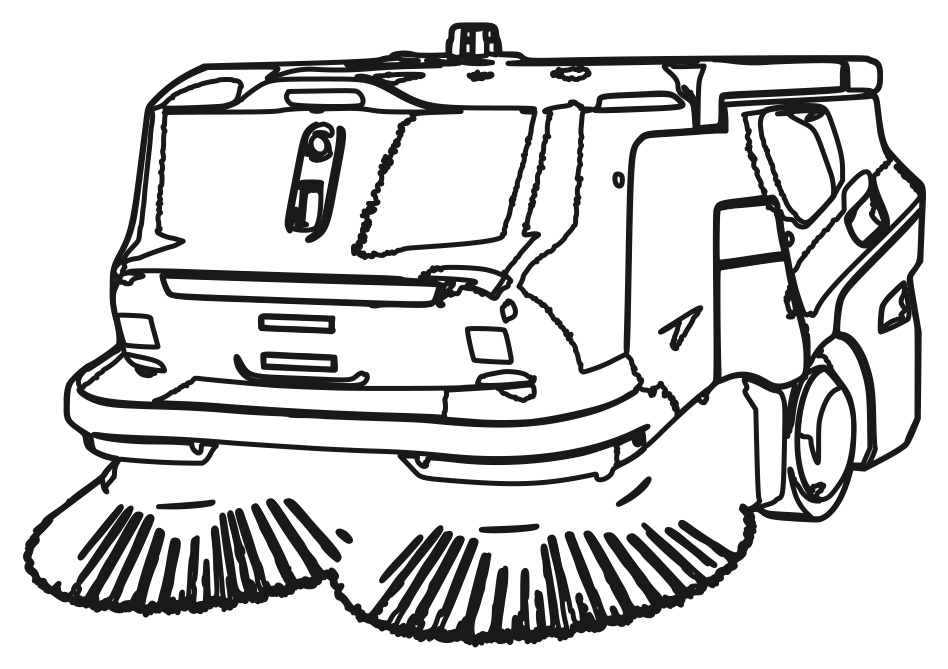
Dry sweepers are the waterless class. The MT1 and the MT1 Max work with dual disc brushes and active dust control — no tank, no water, no drying time, no slip risk, and the floor is walkable the second the machine has passed. Pudu rates the MT1 at max. 1,800 m²/h in standard mode with a 35-litre waste container, and the MT1 Max at max. 2,200 m²/h. The limit of the class is equally clear: sweepers pick up, they do not wash. A film stays a film. The two machines and their real differences are compared in our sweeper comparison.
Vacuums are the dry pick-up class, and the only one that properly handles textile floors. The Whiz covers up to 1,500 m² per charge over three hours, stores up to 600 taught routes and filters 99.97% of PM2.5 particles. The MT1 Vac is officially a three-in-one sweep, vacuum and dust-mop machine that recognises carpet and hard floor in real time, with 55 cm vacuuming width, 70 cm sweeping width and H11 filtration (H13 optional). The NR1700 sits at the other end: 280 mm width, HEPA H13, a 1.4-litre dustbin — and no camera anywhere in its sensor suite.
The fourth class is not a robot at all. The SH1 is an operator-guided upright scrubber-dryer: 44 cm brush width, 27 kg brush pressure, four-litre tanks, 70 minutes of runtime in standard mode. It exists because every real building has areas an autonomous machine will never clean well — behind counters, under fixed tables, in small side rooms. Planning a robot deployment without planning who covers those areas is how robot projects lose their credibility in month two.