
Knowledge

Machine profile · · 8 min read

Pudu MT1 Vac: the MT1 that vacuums instead of sweeping

The name misleads. The Pudu MT1 Vac sits on the same platform as the MT1 sweeper, but it does a different job: it vacuums. Anyone arriving from our MT1 versus MT1 Max comparison and filing the Vac as the family's third sweeper will plan the wrong machine — with consequences for floor covering, operating window and noise. We run this machine in our fleet and checked every published figure against Pudu's official product page, the launch press release and the brochure of Pudu's official partner. Two results up front: the documented performance data are solid — 1,400 m²/h, 20 litres of waste capacity, HEPA H11 as standard. And the one figure that decides the deployment plan in a hotel is not published at all: for the MT1 Vac, no official noise value exists. This article says what that means for planning.

Key takeaways

  • Officially the Vac is an "AI-powered Robotic Sweeper & Vacuum" — a 3-in-1 machine that vacuums at 55 cm width, sweeps at 70 cm with side brushes and dust mops, on carpet and hard floors alike. The job it actually does in service, and the reason the MT1 name misleads, is dry vacuuming.
  • Documented: max. 1,400 m²/h, 20 litres of waste capacity (6 l bin plus two 7 l disposable bags), HEPA H11 as standard (over 98 % of particles down to 0.3 µm), H13 optional (99.97 %), charging under 3.5 h.
  • Pudu publishes neither a noise figure nor a suction value in pascals for this machine. We plan it as a loud machine: offices at night yes, hotel corridors only inside daytime housekeeping windows.
  • Official run-time is 3–6.5 h with exactly one mode-specific figure (4 h in standard sweep-and-vacuum mode on hard floors). There is no official carpet run-time — and therefore no honest coverage calculation for carpet.
01

MT1 is the platform, not the job

The MT1 family is three machines with one chassis. The MT1 is a dry sweeper with dual disc brushes, model MTBC01. The MT1 Max is its outdoor-capable sibling — our comparison of MT1 and MT1 Max works through that pair. The MT1 Vac is model MTBC02, launched on 15 July 2025, and Pudu files it under a different category: "AI-powered Robotic Sweeper & Vacuum". The shared name buys you the same platform, the same navigation stack and the same fleet software. It does not buy you the same cleaning job.

The difference is the pickup mechanism. The MT1 sweeps debris into a 35-litre bin and stays completely waterless; its suction serves dust control, not pickup. The MT1 Vac has a real vacuum path: 55 cm vacuuming width, a twin-fan system, a 6-litre trash bin plus 14 litres of disposable dust bags, and HEPA filtration on the exhaust. Officially it is a 3-in-1 machine — it vacuums, it sweeps at 70 cm working width with side brushes, and it dust-mops, on carpet and on hard floors. We deploy it as our carpet machine, which is our positioning decision, not the limit of the machine. What its siblings do instead is laid out in our sweeping robot comparison.

Physically it is the same footprint as the sweeper: 840 × 600 mm, 490 mm high, 75 kg, driving at 0.2 to 1.2 m/s. Pudu's official partner brochure highlights that the 49 cm height lets it reach under tables and furniture; the same official partner material names venues of up to 100,000 m². What both machines share matters as much as what separates them: neither carries water. The floor is walkable the moment the robot has passed — no drying time, no film, nothing that a scrubber-dryer would leave behind.
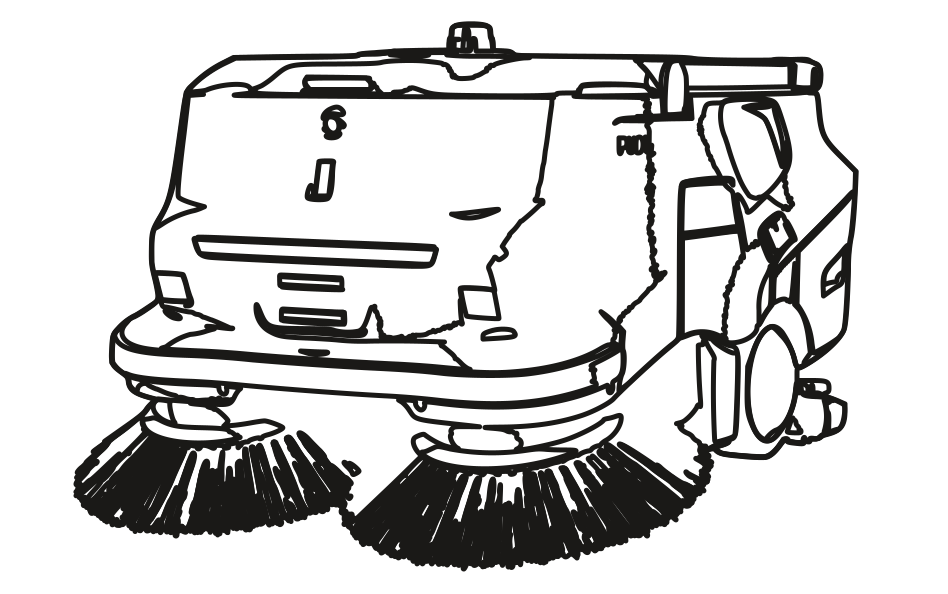
MT1 Vac
MT1 Vacvacuum robot
Pictograms: vectorized 1:1 from our product reference photos — not illustrative icons.
02

What is officially documented — and what is not

These figures come straight from Pudu's official spec table and are identical on the German and English product pages: maximum cleaning efficiency 1,400 m²/h; vacuuming width 55 cm; sweeping width 70 cm with side brush; 6-litre trash bin plus 14 litres of dust bags as two 7-litre units, a total of 20 litres; filter H11 as standard with H13 optional; charging under 3.5 hours; navigation VSLAM plus marker plus LiDAR SLAM. On filtration Pudu is specific: H11 captures over 98 % of particles down to 0.3 µm, and the optional H13 raises that to 99.97 %. The machine returns to an automatic charging station on its own, which is what the official "supports 24/7 operation" claim rests on. One small divergence for the record: the partner brochure gives charging as under 3 hours where the official page says under 3.5 — we use the official page.

Run-time needs care. Officially it is 3 to 6.5 hours, and Pudu names exactly one operating point inside that span: 4 hours in standard sweep-and-vacuum mode on hard floors. Multiplying 4 hours by 1,400 m²/h gives 5,600 m², but that number pairs a maximum area rate with a hard-floor mode and describes two different operating points at once. It is a ceiling, not a planning figure. For carpet — the surface we actually buy this machine for — Pudu publishes no run-time at all, which is why you will not find a carpet coverage figure from us either. It is on our list of open questions to the manufacturer.

Two specifications that circulate do not exist in any source. There is no pascal value for the suction: Pudu's official pages, the launch release and the partner brochure all describe the vacuum qualitatively — an "industry-first twin-fan vacuum design" whose two independent air channels "boost suction efficiency by up to 200 %" (a percentage stated without a baseline), strong enough to pick up debris the size of 3 mm steel balls. If someone quotes you a Pa figure for the MT1 Vac, ask which document it comes from. And there is no decibel value, which is the subject of the next section.

Connectivity is worth one line of honesty as well. The official material confirms IoT integration — the machine is monitored through Pudu's app and can be extended with elevator and access-gate control. A specific "4G / WiFi" specification is documented for the sister MT1, not for the Vac. Capacity, by contrast, has an official field claim behind it: Pudu states up to 10 consecutive days of operation in a 1,000 m² carpeted area before the machine needs emptying — a manufacturer figure, but at least one with its reference area attached.

03

The noise question: Pudu names no number, and that is the important number

We checked the German product page, the English product page, the launch press release and the official partner brochure. None of them contains a decibel value for the MT1 Vac. The only figure anywhere in the market is a German dealer page listing "max. 70 dB" — and that same page mixes in specifications of the base MT1 sweeper, so we do not build a deployment plan on it. Until the manufacturer confirms a value in writing, we publish none — because inventing a plausible figure is exactly how it ends up quoted back as fact.

Low-noise modes do exist. A dealer spec sheet lists a mode set that includes low-noise sweep-and-vacuum, low-noise vacuum and quiet dust mopping; Pudu's own product page names the capabilities — sweeping, vacuuming, dust mopping — but not the modes, and attaches no decibel value to any of them. So the honest state of knowledge is: quieter modes are available, quantified quietness is not.

For planning we therefore treat the MT1 Vac as a loud machine — which is the safe assumption for any commercial twin-fan vacuum. In offices that costs nothing: the machine runs at night on empty floors and nobody is disturbed, the same pattern we describe for night operation generally. In hotels it is a hard constraint. Corridors get cleaned inside the daytime housekeeping window, alongside the trolleys, never on guest floors while people are asleep. If a hotel needs a machine that can run on a sleeping floor, this is the wrong one.

It is fair to note what the alternatives publish, because that is a difference in documentation, not a measured comparison. SoftBank states 62 dB in normal mode for the Whiz in its official data sheet. Nexaro specifies the NR 1700 by mode: 49 dB(A) in Eco, 57 dB(A) in Balanced and Performance. Both manufacturers put a number on paper you can hold them to. For the MT1 Vac, no such number exists — so if noise is the binding constraint in your building, the decision is already made by the documentation.

04

Carpet in practice

The adaptation to the floor is real and officially described. AI-supported floor recognition identifies carpet and hard floor in real time and adjusts brush pressure, roller speed and suction strength accordingly. What it is not — despite descriptions that circulate — is a brush height adjustment that measures pile thickness. The mechanism is pressure and speed, not height, and that distinction matters when you are assessing whether a delicate covering is at risk.

The machine works dry throughout. It carries no water, so a carpet is dry when the robot has passed and the area can be used immediately — no drying time, no risk of over-wetting a textile covering. That also fixes the boundary of the job: stains and the periodic deep cleaning of textile floors remain a wet task that this machine does not take over. Where autonomous vacuuming ends and wet extraction begins is the subject of our article on autonomous carpet cleaning.

One practical point from our own deployments, offered as an observation rather than a specification: a rotating brush on pile leaves visible tracks in the direction of travel, exactly as an upright vacuum does. That is the pile lying down, not a defect, and it disappears with foot traffic. In representative areas — hotel lobbies, executive floors, showrooms — it is still worth planning the route direction deliberately, because a straight, consistent pattern looks maintained while a crossed one looks accidental.

On filtration, keep the claim exactly as large as the documentation. H11 as standard is stated at over 98 % of particles down to 0.3 µm, the optional H13 at 99.97 %; dust is separated into disposable bags. That documents a filter class, not a health outcome — Pudu quantifies no effect on air quality, and neither do we. For allergen-sensitive venues, the H13 option is the lever that exists, and it is worth specifying before installation rather than retrofitting. One consumables note: no official source describes the filters as washable, so we plan them as wear parts on a replacement schedule, together with the dust bags.

05

Where it runs — and where a smaller machine is the better answer

The MT1 Vac earns its area rate on large, contiguous carpet. In offices that means open-plan floors, corridors and meeting zones cleaned at night: the machine leaves the dock on its own, works unattended and returns to charge, which is what makes the official 24/7 claim usable in practice. In hotels it means corridor and event-area carpet inside the daytime housekeeping window — congress and event floors between two events are the cleanest fit, because they are large, empty and carpeted at exactly the times nobody is sleeping nearby. Pudu's partner brochure additionally names warehouses, airports and shopping centres, which fits the venue size that same material quotes.

The comparison with the two vacuum alternatives is mostly a question of area and staffing model. The NR 1700 is a 280 mm machine rated at max. 100 m²/h with 250 minutes of run-time in Eco mode; Nexaro positions it for lobbies, showrooms and open-plan offices, and at that area rate it belongs on the smaller carpeted units. It is camera-free by design, which also settles a good deal of data protection discussion before it starts. The Whiz sits in the middle at 465 to 557 m²/h and 3 hours per charge, with HEPA filtration rated at 99.97 % of PM2.5 particles — but it is a cobot: a member of staff guides each route once and starts each run at the machine. Two of the three therefore run dock to dock: the NR 1700 datasheet lists automatic recharging, and the MT1 Vac leaves its dock, works and returns on its own. Only the Whiz needs a person present for every run. Where the MT1 Vac pulls away is throughput — up to 1,400 m²/h, and the field rates we measured on the NR 1700 are in our NR 1700 field report.

So the decision runs along three questions. How much contiguous carpet is there — a few hundred square metres, a couple of thousand, or a whole trade-fair floor? Is there staff on site to start runs, or does the machine have to work through the night alone? And do you need a published noise figure to get the deployment approved? On the first two the MT1 Vac wins at scale; on the third it is the only one of the three that cannot answer. Our vacuum robot comparison puts the machines side by side in detail.

The remaining limits are worth naming plainly. Pudu specifies no pile heights and no carpet types, so we do not quote a percentage of carpets the machine handles — we check the covering on site before installation, which is the only honest version of that answer. Run-time on carpet is undocumented. Noise and suction pressure are undocumented. Everything else in this article is on paper at the manufacturer, and if you want to see the machine on your own floor covering rather than in a spec table, that is what a demo is for.

06

Frequent questions

It vacuums. Pudu files it officially as an "AI-powered Robotic Sweeper & Vacuum" — a 3-in-1 machine that vacuums at 55 cm width, sweeps at 70 cm with side brushes and dust-mops, on carpet and hard floors. The plain MT1 that shares its name is a pure dry sweeper with dual disc brushes and a 35-litre bin, with no vacuum path and no HEPA filtration. Same platform, different job.

Pudu publishes no decibel value for this machine. The German and English product pages, the launch press release and the official partner brochure are all silent on noise; the only figure in the market is a single dealer page quoting max. 70 dB, on a page that mixes in specifications of the base MT1. Until the manufacturer confirms a value in writing, we plan the machine as loud: offices at night are unproblematic, hotel corridors only inside daytime housekeeping windows, never on guest floors while people are asleep.

Officially 3 to 6.5 hours, depending on mode. Pudu names exactly one operating point inside that range: 4 hours in standard sweep-and-vacuum mode on hard floors. There is no official run-time for carpet operation, so any coverage figure for carpet would be guesswork. Charging takes under 3.5 hours, and the machine docks automatically, which is what supports continuous operation across a night.

Pudu specifies neither pile heights nor carpet types, so no honest percentage of suitable carpets exists — we check the covering on site before installation. What is documented is the adaptation mechanism: AI floor recognition identifies carpet and hard floor in real time and adjusts brush pressure, roller speed and suction strength. It is not a brush height adjustment based on pile thickness, even though that description circulates.

Total waste capacity is 20 litres: a 6-litre trash bin plus two disposable 7-litre dust bags. Pudu states up to 10 consecutive days of operation in a 1,000 m² carpeted area before emptying is required — a manufacturer figure that at least names its reference area, and one that scales down with area size and soiling. Bags and filters are consumables; no official source describes the filters as washable.

See it instead of reading?

We show you the machines in 30 minutes at your site — free and non-binding.

Request a demo
Pudu MT1 VacView machine →WhizView machine →Nexaro NR1700View machine →