Knowledge

Comparison · · 7 min read

Pudu MT1 vs. MT1 Max: What Actually Separates the Two Sweepers

On most dealer pages the Pudu MT1 and MT1 Max look like one machine in two trim levels: standard and premium. That is the wrong story. Both are pure dry sweepers — no water, no drying time — and they share cleaning width, waste container and footprint. The real differences sit somewhere else than the datasheets suggest: officially, the Max is not an indoor premium unit at all but a machine for semi-outdoor areas. We verified every published figure against Pudu's own documentation — product pages, product brochure, product deck, launch release. Some of the advertised differences are real and well documented. Others — transparent-obstacle detection, an "Analytics Pro" dashboard, quieter operation — appear in no official source. This article separates the two and ends with which machine fits which operation.

Key takeaways

  • Identical on both: 70 cm cleaning width, 35 L waste container, 840 × 600 mm footprint, 0.2–1.2 m/s, dry sweeping without any water, and the same PUDU Link app.
  • Genuinely different: 2,200 instead of 1,800 m²/h, 60 instead of 45 Ah, 3D LiDAR plus dual-SoC computing, and 20 kg more weight in a 185 mm taller body.
  • Pudu built the Max for semi-outdoor areas — parking garages, courtyards, sidewalks — with IP54, a water-drop sensor, 5 cm bump crossing and 8° slopes. Its official product name says exactly that.
  • Not real: transparent-obstacle detection, an "Analytics Pro" dashboard, or quieter operation. Pudu publishes no noise figure for either machine, and the only dealer values make the Max the louder one.

CC1 vs. CC1 Pro — verified data

MT1MT1 Max
Platform — identical
Footprint (L × W)840 × 600 mm840 × 600 mm
Cleaning width70 cm70 cm (with side brush)
Waste container35 L35 L
Cruise speed0.2–1.2 m/s (adjustable)0.2–1.2 m/s (adjustable)
Cleaning methodDry sweeping, no waterDry sweeping, no water
AI trash recognition · spot cleaning
SoftwarePUDU Link appPUDU Link app
Elevator / e-gate module (optional)
Venue positioningover 100,000 m²over 100,000 m²
Actual differences
Height490 mm675 mm
Weight65 kg85 kg
Coverage rate (standard mode)max. 1,800 m²/hmax. 2,200 m²/h
Coverage rate (spot mode)max. 6,000 m²/hmax. 7,000 m²/h
Run-time4–8 h (by cleaning level)5–10 h, standard mode 8 h
Battery45 Ah60 Ah
Charging time< 3 h< 3.5 h
NavigationVSLAM + Marker + Lidar SLAMVSLAM + Marker + 3D LiDAR SLAM
Computing architecturenot officially statedDual SoC, "doubles computing power"
Obstacle crossing20 mm thresholds, 35 mm grooves5 cm speed bumps, 8° slopes
Min. path clearance75 cmnot officially stated
MT1 Max only — semi-outdoor & signalling
IP ratingIP54 (full sealing)
Water-drop sensor with avoidance mode
Operating temperature0–40 °C indoors (manual)−10 to 45 °C, with temperature sensor
1.2 m warning light + safety projection light
Automatic filter cleaning (vibration)

Noise is missing on purpose: Pudu publishes no noise figure for either machine. The only German dealer values are max. 70 dB for the MT1 and below 75 dB for the MT1 Max — which would make the Max the louder machine, not the quieter one.

01

What both machines actually share

Per Pudu's official spec tables, the MT1 and the MT1 Max stand on the same footprint: 840 × 600 mm in length and width, a 70 cm cleaning width, a 35-litre waste container and an adjustable cruise speed of 0.2 to 1.2 m/s. Both are dual-disc brush sweepers, and neither has a water tank in any official document — Pudu calls it "professional dry cleaning" for both. Floors are walkable the moment the machine has passed, which is the whole point of putting a sweeper rather than a scrubber on an industrial floor.

The intelligence layer is the same in kind, too. Both carry AI trash recognition via camera, both have an AI spot-cleaning mode for patrol runs, both are managed through the PUDU Link app with remote monitoring by phone or PC, cleaning reports and bin-overflow alerts, and both can be extended with the optional elevator and e-gate control modules for multi-floor operation. There is no separate premium software product for the Max — a point we return to below.

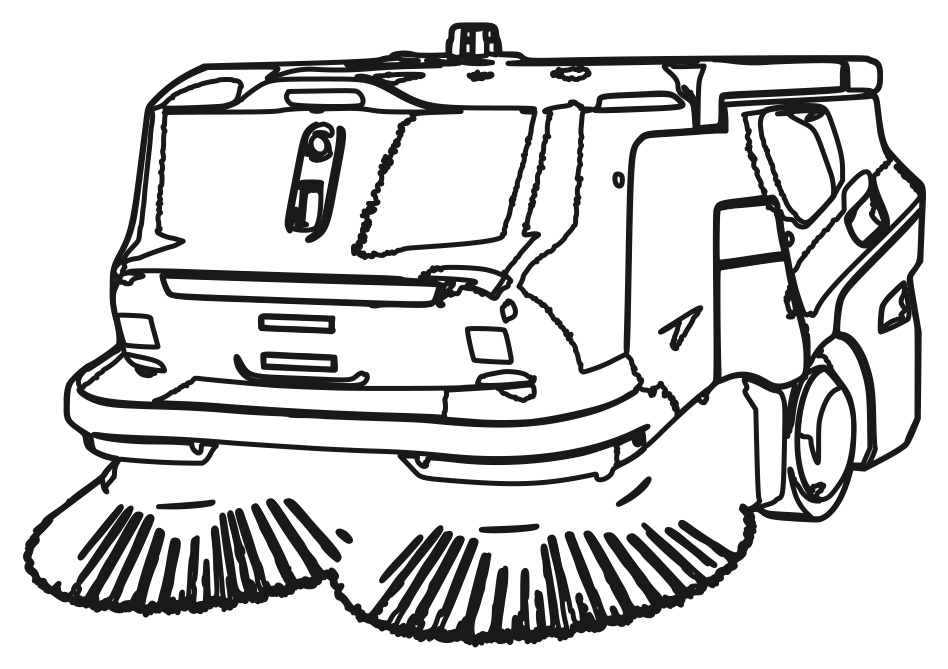
The consequence matters for sizing. The Max is not the wider machine and not the bigger-bin machine. It empties as often as the MT1 and covers the same width per pass. What it is: 185 mm taller and 20 kg heavier, and that extra mass buys perception hardware and weather sealing — not more sweeping.
MT1
MT1 Max
MT1MT1 Max
Pictograms: vectorized 1:1 from our product reference photos — not illustrative icons.
02

The differences that are real

Throughput and endurance are genuinely better, and both figures come straight from the official spec tables. The Max is rated at max. 2,200 m²/h in standard mode against the MT1's max. 1,800 m²/h, and 7,000 against 6,000 m²/h in spot mode. Its battery grows from 45 to 60 Ah, run-time from an officially stated 4–8 h to 5–10 h with standard mode explicitly given as 8 h, while it charges slightly longer (< 3.5 h instead of < 3 h). One caveat that applies to both machines: Pudu writes the MT1's run-time as "differentiated by cleaning levels", so multiplying the maximum area rate by the maximum run-time describes two different operating points at once. It is not a coverage figure.

Perception is the second real gap. The MT1 navigates with VSLAM + Marker + Lidar SLAM; the Max adds a 3D LiDAR to that stack — officially "VSLAM + Marker + 3D LiDAR SLAM" — and runs it on a dual-SoC architecture that, in Pudu's words, "doubles computing power to enable more precise AI recognition and faster processing, while built-in redundancy ensures stable operation." Pudu's launch release quantifies the sensing as centimetre-level accuracy with a detection range up to 150 metres. Practically, the deck describes behaviour the base machine is not credited with: the Max stops to let vehicles pass, pauses at lane entrances, or edges aside while keeping the route clear, and reacts to sudden movement from people or animals.

Third, mobility and signalling. The MT1 officially crosses 20 mm thresholds and 35 mm grooves and needs a minimum path clearance of 75 cm. The Max crosses 5 cm speed bumps and climbs slopes up to 8°; Pudu states no path clearance for it. And the Max carries what the MT1 does not: a 1.2-metre-high warning light plus a safety projection light with audible and visual alarms — its component diagram even labels a dedicated forklift safety light. The base MT1's component diagram lists only a fill light, which illuminates the camera's field of view rather than warning anyone. If mixed traffic with forklifts is the reason you are buying, that signalling package is a Max feature, not an MT1 feature.

03

The Max is built for semi-outdoor areas — not for "indoor, but better"

This is the single most-omitted fact in German listings of this machine. Pudu's official product title is "AI-Powered Outdoor & Semi-Outdoor 3D Perception Robotic Sweeper". The launch release places it in "large-scale indoor and semi-outdoor cleaning in environments such as underground parking garages and semi-open building atriums". The product deck opens with the sentence: "Building on MT1, MT1 Max is enhanced for semi-outdoor environments such as residential courtyards and for areas with high-speed dynamic obstacles like parking garages." The Max is not the premium indoor MT1. It is the MT1 for floors that see weather and vehicles.

The hardware backs the positioning. Full IP54 sealing against dust ingress and water spray, a water-drop sensor that triggers a protective avoidance mode and routes the robot to safe zones, an operating range of −10 to 45 °C with a temperature sensor, plus the bump and slope figures above and an automatic filter-cleaning vibration system that keeps suction and filtration stable without manual upkeep. Pudu's own scenario gallery lists parking garages, residential courtyards, sidewalks, urban squares, park trails, waterfront and supermarket parking lots and train station squares alongside the indoor scenes. That is a different machine brief from the base MT1, whose official material contains no IP rating and no outdoor scenario at all — and whose manual limits it to 0–40 °C indoors.

The limit is stated just as plainly, and it belongs in any honest comparison: Pudu footnotes the water-drop sensor with "Do not perform cleaning tasks in extreme weather." Semi-outdoor means a parking garage, a covered loading yard, a courtyard — not a municipal street sweeper in the rain. Treat the IP54 rating as protection against splash and dust, not as a licence to run the machine through a storm.

04

The honest fine print

Noise first, because it is the specification most often invented for this pair. Pudu publishes no noise value for the MT1 or the MT1 Max — not on the product pages, not in the brochure, not in the product deck. That is unusual for the manufacturer: the CC1 scrubber carries an official below 70 dB(A), as we set out in our CC1 versus CC1 Pro comparison. The only sourced figures for the sweepers come from one German dealer, which lists max. 70 dB for the MT1 and below 75 dB for the MT1 Max. Take that for what it is — a single non-official source — but note the direction: nothing supports the Max being the quieter machine. If a spec sheet promises you below 65 dB on either unit, ask for the official document behind it.

Three advertised differentiators have no official basis at all. First, transparent-obstacle detection: the claim that the Max's 3D LiDAR reliably recognises glass doors or protective films appears in no Pudu source. Glass is mentioned once, and only as a mapping condition — the Max keeps stable navigation under glass rooftops. LiDAR is physically weak on transparent surfaces; do not buy the machine for this. Second, an "Analytics Pro" dashboard with heatmaps, efficiency scores and PDF export: no Pudu product of that name exists. Both machines run PUDU Link, with real-time updates, cleaning reports and overflow alerts. Third, "premium components", reinforced brushes or longer-lasting wear parts: nothing official supports this either. The Max's real maintenance advantage is the automatic filter cleaning.

Finally, two traps when reading any spec sheet for this family. One is arithmetic: 1,800 × 8 or 2,200 × 10 produces impressive per-night numbers that Pudu's own run-time footnote does not support, because the top area rate and the top run-time are not the same operating point. The other is identity. The MT1 line is three machines — the MT1, the MT1 Max, and the MT1 Vac, which is a vacuum rather than a sweeper — and some dealer pages carry MT1 Vac figures under an MT1 heading. Before comparing two numbers, check that they describe the same robot. Our sweeper robot overview sorts the class out in more detail.

05

Which one for which operation

The MT1 is the right machine for closed halls on hard floors. In warehouses and logistics centres and production halls, the constraints that decide the job are aisle width, thresholds and dust — and there the MT1's officially documented 75 cm path clearance, 20 mm threshold and 35 mm groove crossing describe the actual situation well. Nothing on that floor exercises IP54 sealing, a rain sensor or 8° slope climbing. If your operation is a roofed hall with normal thresholds, the Max adds height, weight and throughput, and little else you will use.

The MT1 Max earns its place where the floor stops being purely indoor. Parking garages with ramps and speed bumps, covered loading yards, courtyards, entrance zones that catch weather: that is the brief Pudu wrote the machine against, and the IP54 sealing, water-drop sensor, temperature range and 5 cm bump crossing are the reason it works there. The second case is traffic. Where vehicles and robots share lanes, the 1.2-metre warning light, the projection light and the 3D LiDAR's vehicle-aware behaviour are the difference that matters — more than the extra 400 m²/h.

Which leaves the throughput question, and it is worth being blunt about it. If you need more area per night and nothing else, two MT1s cover more ground than one Max, and they cover it in two places at once. The Max is the answer when the environment is harder, not merely bigger. Either way, resist sizing the machine from the datasheet: book a trial run on your own floor and measure what one unit actually completes in one shift, with your thresholds, your aisle traffic and your soiling. That number is the only one worth planning with.

06

Frequent questions

Cleaning width (70 cm), waste container (35 L), footprint and cruise speed are identical, and both are waterless dry sweepers. The Max is officially rated at 2,200 instead of 1,800 m²/h in standard mode, has a 60 Ah instead of 45 Ah battery, adds a 3D LiDAR and dual-SoC computing, and is sealed to IP54 with a water-drop sensor for semi-outdoor areas. It is also 185 mm taller and 20 kg heavier.

There is no official answer, because Pudu publishes no noise value for either machine. The only sourced German dealer figures are max. 70 dB for the MT1 and below 75 dB for the MT1 Max, which points the other way. Do not choose the Max for noise reasons, and treat any figure below 65 dB on either machine as unsourced until a Pudu document backs it.

Pudu makes no such claim anywhere in its official material. Glass appears once, and only as a mapping condition: the Max navigates stably under glass rooftops. Transparent surfaces are physically difficult for LiDAR, so treat reliable glass-door detection as an unverified dealer claim rather than a documented capability.

Semi-outdoors, yes — that is what Pudu built it for. It carries full IP54 sealing, a water-drop sensor with a protective avoidance mode, an operating range of minus 10 to 45 degrees Celsius, 5 cm bump crossing and 8 degree slope climbing, and Pudu lists parking garages, courtyards, sidewalks and urban squares among its scenarios. Pudu also states plainly that cleaning tasks must not be performed in extreme weather, so it is not a street sweeper. The base MT1 carries no IP rating, and its manual limits it to indoor use at 0 to 40 degrees Celsius.

Pudu publishes no per-run coverage figure, and the common shortcut of multiplying the maximum area rate by the maximum run-time overstates it: the official run-time is given as 4 to 8 hours differentiated by cleaning level, so the top rate and the longest run-time are not the same operating point. The reliable way to size a deployment is a trial run on the actual floor, measuring one full shift with your thresholds, aisle traffic and soiling.

See it instead of reading?

We show you the machines in 30 minutes at your site — free and non-binding.

Request a demo
Pudu MT1View machine →Pudu MT1 MaxView machine →