Knowledge

Comparison · · 10 min read

Robotic Sweepers Compared: Six Machines on the German Market

A robotic sweeper is a dry machine. Brushes move loose debris into a hopper, a blower pulls the airborne dust through a filter, and the floor is walkable and driveable the moment the machine has passed. That single sentence rules out most of what people expect when they search for one. Six autonomous dry sweepers are realistically available in Germany today, and four of them are in our programme: the Pudu MT1 and the MT1 Max, which we run ourselves, plus the CenoBots S5 and the Adlatus SR1300, which are newly onboarded. The remaining two — Kemaro K900 Gen II and K700 Compact — we have researched from their own documentation, and we say so at every point below. Every figure in this article comes from a manufacturer datasheet, product page or brochure we read ourselves. Where a manufacturer publishes nothing, this article says nothing.

Key takeaways

  • Sweeping is dry: no water, no drying time, no removal of anything that sticks to the floor. A sweeper never replaces a scrubber-dryer — it runs before one.
  • The six machines split into two tiers: compact venue and hall sweepers (Pudu MT1/MT1 Max, Kemaro K900/K700) and heavy industrial systems (CenoBots S5, Adlatus SR1300 at 485 kg). Four of the six are in our programme; the two Kemaro machines are market coverage.
  • The m²/h figures are not comparable. Measured against each machine's own geometric maximum, the manufacturer figures range from roughly 43% to roughly 98% of the ceiling.
  • Not one manufacturer publishes a dB(A) value for these six machines. And only the Adlatus system empties its own hopper — on the other five, a human still does it.

CC1 vs. CC1 Pro — verified data

Pudu MT1MT1 MaxCenoBots S5Adlatus SR1300Kemaro K900 Gen IIKemaro K700
Coverage and pickup
Cleaning rate (manufacturer figure)1,800 m²/h2,200 m²/h~2,500 m²/h5,000 m²/h (theoretical)1,000 m²/h750 m²/h
Sweeping width700 mm700 mm820 mm800–1,271 mm900 mm700 mm
Debris hopper35 l35 l50 l115 l35 l11 l
Max. speed1.2 m/s1.2 m/s1.4 m/s1.11 m/s0.7 m/s0.7 m/s
Power and format
Runtime4–8 h5–10 h (standard mode 8 h)5–7 hup to 8 h (max. battery fit-out)up to 4 hup to 4 h
Charging time< 3 h< 3.5 h2 h5 h (2.5 h with double charger)90 min90 min
Weight65 kg85 kg130 kg485 kg32 kg< 25 kg
Height490 mm675 mm990 mm1,500 mm350 mm250 mm
Navigation and dust control
NavigationVSLAM + marker + Lidar SLAMVSLAM + marker + 3D LiDAR SLAM32-beam 3D LiDAR, 100 TOPS2D + 3D lidar, camera-free2D LiDAR 270° + 3D camera2D LiDAR 270° + 3D sensor
Dust controlNegative pressure + filterNegative pressure + automatic filter cleaningHEPA + filter shakerClass M, 5.5 / 6.4 m², automatic shaking2 m² air filter + Automatic Filter Cleaner2 m² air filter + Automatic Filter Cleaner

There is no noise row because not one manufacturer publishes a dB(A) value for these six machines. There is no gradient row either: Pudu states no slope figure for the base MT1, only 20 mm thresholds and 35 mm grooves. The cleaning rates are the manufacturers' own and are not measured the same way — see section 04. Spot-cleaning modes (MT1 6,000 m²/h, MT1 Max 7,000 m²/h) are separate operating modes, not full-area cleaning.

01

What a robotic sweeper is — and what it is not

The mechanism is the same on all six machines. Rotating brushes move loose material into a hopper while a blower puts the housing under negative pressure and draws the raised dust through a filter. Pudu calls this "Active Dust Control", Kemaro calls it dust extraction, and Adlatus filters to class M. No water is involved anywhere in the process — no fresh-water tank, no waste water, no dosing, no drying time. The floor behind the machine is dry, and forklifts can drive on it immediately.

What follows from that is the part buyers underestimate: a sweeper removes nothing that adheres. Tyre marks, dried-on spills, grease film, liquids — all of that needs water, brush pressure and a squeegee, which means a scrubber-dryer. Kemaro states explicitly that the K900 does not sweep liquids. The Adlatus datasheet is equally clear that the SR1300 sweeps and vacuums but does not scrub. If your problem is stains, a sweeper is the wrong class of machine, no matter how good it is.

The third class in the field are vacuum robots, which are built for carpet and textile floors in offices and hotels — a different floor type and a different job. In practice the two dry-and-wet classes belong in sequence rather than in competition: sweep first so the coarse debris is gone, scrub afterwards for the film that stays behind. CenoBots formalises exactly this as "TeamClean" between the S5 and its scrubber-dryers, and Adlatus positions the SR1300 the same way. Which class fits your building is the question our class overview walks through.

02

The two with our own operating hours: Pudu MT1 and MT1 Max

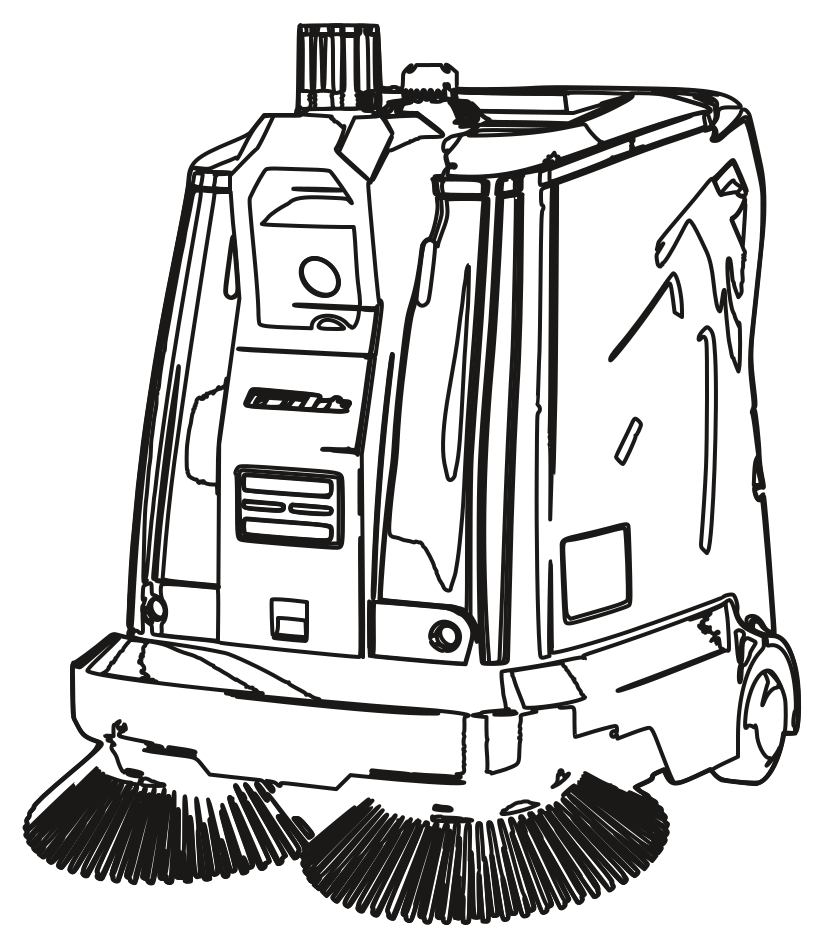
The Pudu MT1 is the compact end of the field: 840 × 600 × 490 mm, 65 kg, a 700 mm sweeping width from dual-disc brushes and a 35-litre hopper. Pudu states a maximum of 1,800 m²/h in standard cleaning mode and 6,000 m²/h in AI spot-cleaning mode, a 45 Ah battery, a runtime of 4–8 hours "differentiated by cleaning levels" and under 3 hours of charging. Navigation is VSLAM plus positioning markers plus Lidar SLAM. Two numbers matter more than the headline rate for planning: it needs a minimum path clearance of 75 cm, and it crosses 20 mm thresholds and 35 mm grooves. The manual restricts it to flat, hardened indoor floors.

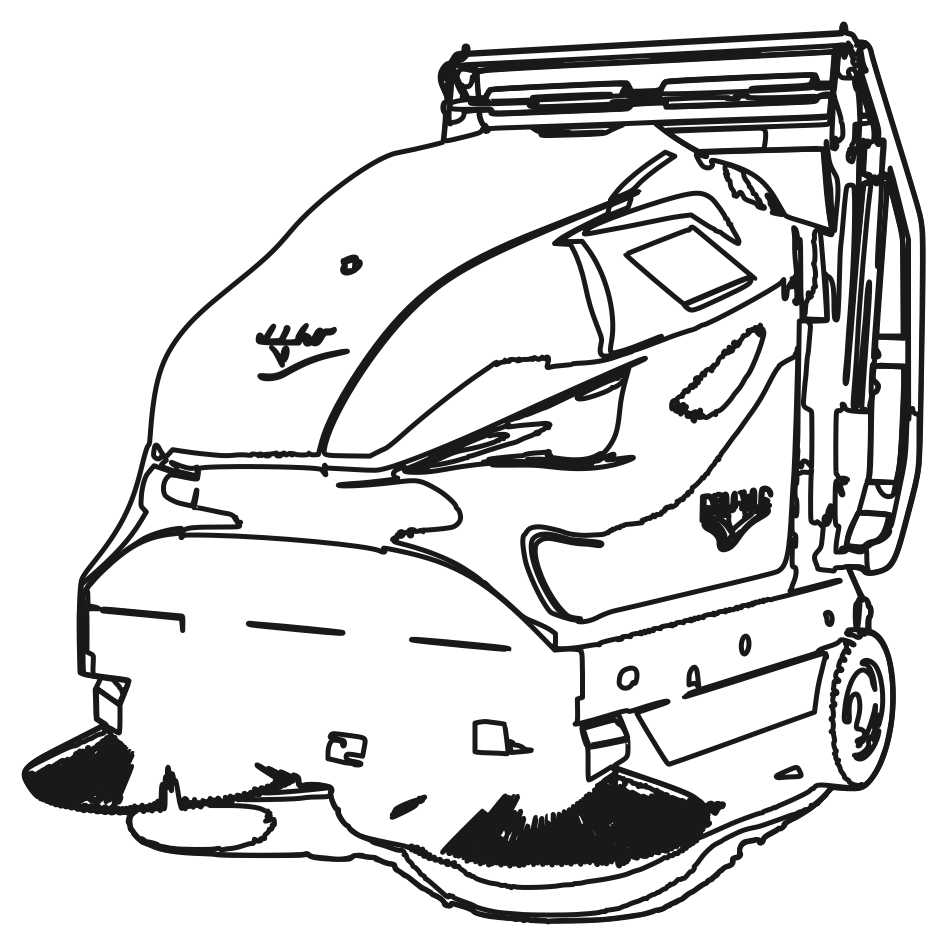
The MT1 Max is not simply a bigger MT1. Same 700 mm width and 35-litre hopper, but 2,200 m²/h (7,000 m²/h in spot mode), a 5–10 hour runtime with standard mode stated at 8 hours, under 3.5 hours of charging, 85 kg and 675 mm tall, and a 3D LiDAR added to the navigation stack. The real difference is where it may go: full IP54 sealing, −10 to 45 °C operating range, 5 cm speed bumps, 8° slopes, a 1.2-metre warning light plus a safety projection light, and an internal vibration system that keeps the filter clear during the run. Pudu markets it as an outdoor and semi-outdoor sweeper — parking areas, courtyards, station forecourts. The machine-by-machine detail is in our MT1 versus MT1 Max comparison.

What we do not do is multiply runtime by cleaning rate. Pudu gives 4–8 hours for the MT1 and states plainly that the range is differentiated by cleaning level — the 8 hours sit at the low-intensity end, not at 1,800 m²/h. On the Max, "5–10 h" is printed next to "standard mode 8 h". Anyone multiplying 2,200 by 10 produces a number that appears in no Pudu document. Nor does Pudu publish a coverage-per-hopper figure or a dB(A) value for either machine, and we are not going to invent one.

MT1
MT1 Max
S5
SR1300
MT1MT1 MaxS5SR1300
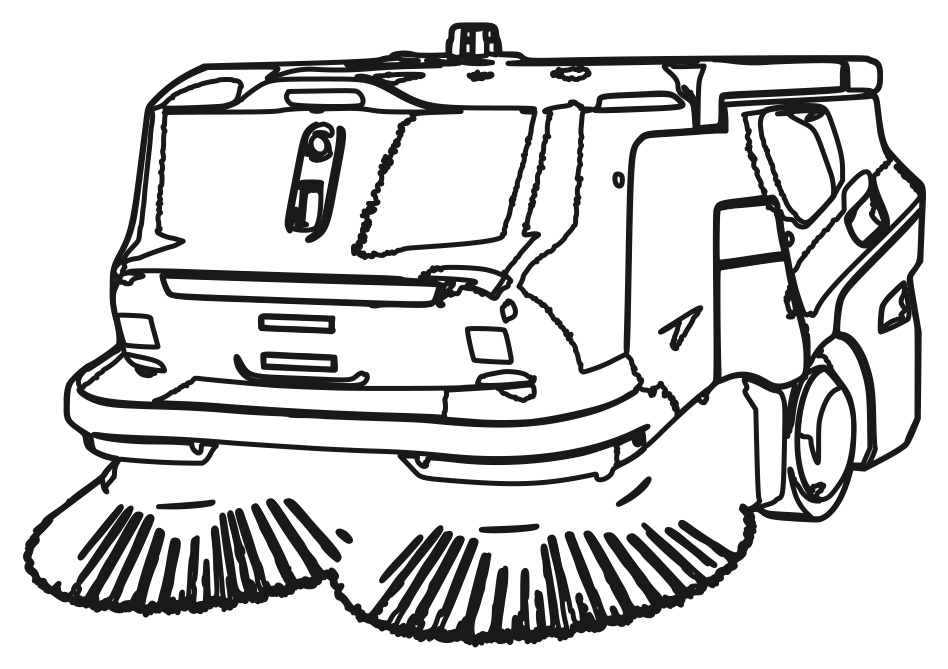
The four sweepers in our program, vectorized 1:1 from official reference material — not illustrative icons.
03

The other two in our programme — and the rest of the market

Two of the four machines in our programme are covered here: the CenoBots S5 and the Adlatus SR1300, both newly onboarded. The two Kemaro machines are market coverage. Either way, everything in this section comes from official datasheets, brochures and product pages that we read at the source: treat it as documentation.

The CenoBots S5 is a heavier industrial sweeper: ~2,500 m²/h, 820 mm sweeping width, a 50-litre hopper, 130 kg, 1,030 × 720 × 990 mm, an LFP battery with 75 Ah, 5–7 hours of runtime and a 2-hour fast charge. It passes through 810 mm doorways, cleans to 0 cm from the wall and climbs 8°. The sensing is the strongest on paper in this group — a 100 TOPS NVIDIA chip and a 32-beam 3D LiDAR with up to 150 m detection range — and the manufacturer explicitly claims vehicle recognition for forklifts and AGVs. Dust control is HEPA filtration with an automatic filter shaker, and the debris range named in the brochure is unusually specific: wood chips, packaging film, plastic bottles, cardboard, screws. One caveat on the marketed 24/7 operation: 2 hours of charging against 5–7 hours of running means a single unit is out of service for roughly a quarter of the cycle.

The Adlatus SR1300 is the outlier of the six and a different category of purchase. Per datasheet v3.0 it weighs 485 kg and measures 1,700 × 1,300 × 1,500 mm — the Adlatus website and older documents state deviating values for both, a conflict worth clarifying in any quote — and it sweeps 800 mm with the main brush and up to 1,271 mm with two side brushes, and carries a 115-litre hopper with 5.5 m² pocket or 6.4 m² cartridge class-M filters that are cleaned automatically. A 24 V system with 2.63 kW installed power runs on 3 to 8 battery modules, roughly 180 Ah expandable to 480 Ah, for up to 8 hours in the maximum battery fit-out — dealers corroborate roughly 2.5 hours for the standard version; charging takes 5 hours, or 2.5 with the double-charger configuration. It drives 1.11 m/s, climbs 20% gradients and needs 3 metres between walls to turn around. Two things set it apart: the machine navigates with 2D and 3D lidar and deliberately without high-resolution cameras, offline and without a permanent internet connection, which Adlatus positions as GDPR privacy by design; and the S1300 service station charges inductively and empties the hopper on its own, discharging up to 1,450 mm into a standard DIN EN 840 container of 1,100 litres. The datasheet states CE certification and collision avoidance to performance level D per EN IEC 63327. Adlatus states that it develops and manufactures in Ulm, Germany, and has been partnered with NEURA Robotics since September 2025.

Kemaro AG in Eschlikon, Switzerland, covers the other end with two low, light machines. The K900 Gen II does 1,000 m²/h at 90 cm width, 35 litres, up to 4 hours on a charge with a 90-minute recharge, 32 kg, 79 × 72 × 35 cm, 12% ramps, IP54, a 2 m² air filter with a patented Automatic Filter Cleaner, a 270° 2D LiDAR crown plus a 3D camera, and the BlueSpot light that projects the robot's movement for forklift drivers. One docking station covers up to 20,000 m² and multiple stations scale to 100,000 m²; the variants ECO, SMART and TOP are sold by area, with a K-Integrated version for fleet-management systems. Kemaro's FAQ explicitly forbids operation in ATEX zones and the sweeping of flammable or explosive substances. Note one conflict: the current factsheet and Kemaro's own 2025 press release say 4 hours of runtime, while Kemaro's Knowledge Hub and most dealers still carry the first generation's 5 hours. We use 4. The K700 Compact is the same technology at 750 m²/h and 70 cm width, 11 litres and under 25 kg, built around one number: 25 cm total height, low enough to clean under racking and machines. Its maximum debris size is stated as a 35 × 100 mm cylinder. Availability is the caveat: Kemaro itself writes that the K700 is "set to launch" and "already seeing high pre-order volumes", and in August 2026 no German dealer listed it for sale. Kemaro also publishes nothing about whether it uses a docking station at all.
04

Selection criteria: what actually decides

Start by distrusting the m²/h figure — including ours. Multiply sweeping width by top speed and you get each machine's geometric maximum, the area it would cover driving straight ahead with no turns, no overlap and no obstacles. The gap between that ceiling and the published figure is wildly different across the six. Adlatus states 5,000 m²/h against a geometric maximum of about 5,080 and labels its own number "theoretical". Kemaro states 1,000 m²/h for the K900 Gen II against about 2,270 — less than half the ceiling. Pudu's MT1 sits at 1,800 against about 3,020, the S5 at ~2,500 against about 4,130, the K700 at 750 against about 1,760. Putting those numbers side by side does not compare machines, it compares publishing conventions. Ask every vendor how the figure was derived.

Then look at what is actually on your floor. Fine dust, wood or metal particles argue for class-M filtration with automatic cleaning — certified class M on the Adlatus SR1300 and the Kemaro K900; the K700 has an automatic filter cleaner without a published filter class; the S5 uses HEPA with a filter shaker. Bulky, light debris — film, cardboard, empty bottles — is a different problem, and CenoBots is by some distance the most explicit about it — though not the only one, since Pudu’s MT1 brochure names debris „like leaves and bottles" in passing. Kemaro publishes a hard limit instead: a 35 × 100 mm cylinder on the K700. Hopper size follows from soiling, and the spread is a factor of ten, from 11 litres on the K700 to 115 on the SR1300. How many square metres one filling covers is something no manufacturer publishes for any of the six machines — so nobody can honestly tell you, us included.

The criterion most quotes skip is who empties the machine. Five of the six dock and recharge on their own — for the K700, Kemaro publishes nothing on charging — yet apart from the Adlatus a person still walks over, pulls the hopper and carries it to a bin. Only the Adlatus system closes the loop: the S1300 station empties the 115-litre hopper automatically into a 1,100-litre container. That is the real line between "autonomous" and "unattended", and it decides whether a night shift runs without staff on site. Docking coverage is worth asking about too: Kemaro publishes up to 20,000 m² per station, Pudu ships the MT1's dock as optional equipment rather than as standard, and for the K700 Kemaro publishes nothing at all.

Finally, navigation and traffic. If the machine shares floor with forklifts, look for documented features, not adjectives: the S5 claims vehicle recognition with avoidance path planning, Kemaro projects the BlueSpot for drivers and adds mechanical drop protection, the MT1 Max carries a 1.2 m warning light plus a projection light with audible alerts, and Adlatus certifies collision avoidance to performance level D per EN IEC 63327. For the base MT1, Pudu documents multi-sensor collision avoidance but says nothing about vehicles specifically — running it in forklift traffic rests on general obstacle detection, not on a documented vehicle function. Access constrains the choice from the other side: the K700 at 25 cm goes under racking that nothing else here reaches, while the SR1300 at 1.5 m tall needs 3 m between walls to turn, and the MT1 needs 75 cm of clear path. One more procurement note: of the six, only the Adlatus datasheet states CE certification outright. That does not mean the others lack it — it means you request the declaration of conformity from the dealer instead of assuming it.

05

Where sweepers belong — and where they do not

The natural home is the warehouse. In logistics halls the soiling is exactly what these machines are built for — pallet abrasion, packaging film, cardboard, dust on sealed concrete — and the floor is wide, hard and continuous. All six machines are positioned for warehousing and logistics. Adlatus pitches operation "outside working hours" as the default, which matches how these machines are actually run in Germany: at night or in the gap between shifts.

In production the filter matters more than the cleaning rate. Wood and metal dust are a process problem before they are a cleanliness problem, which is why class-M filtration with automatic cleaning is the relevant specification and why Kemaro extends its filter service interval through its Automatic Filter Cleaner. Two hard limits belong on the table here: Kemaro explicitly forbids the K900 in ATEX zones and around flammable or explosive substances, and the Adlatus decision to navigate without high-resolution cameras is what makes it viable in prototype shops and security-sensitive halls where camera-based robots are not allowed through the door.

Parking garages are the scenario that separates the machines. It needs ramps, speed bumps and tolerance for damp, dusty air. The MT1 Max is built for it — IP54, 5 cm bumps, 8° slopes, −10 to 45 °C — and the S5 crosses speed bumps and climbs 8° as well; Adlatus lists parking garages as an official target industry, though it publishes no IP rating, so covered decks only. The base MT1 does not belong here: its manual restricts it to flat, hardened indoor floors, and no gradient figure is published for it at all.

Where they do not belong: carpet of any kind, wet areas, and guest-adjacent quiet zones. And that last one deserves a plain statement rather than a reassurance. Not one of the four manufacturers behind these six machines publishes a dB(A) value for its sweeper. Dealer figures circulate, but a shop listing is not a datasheet value — which is why there is no noise row in the table above and why we do not promise quiet daytime operation for any machine in this class. If a supplier quotes you a decibel number, ask which manufacturer document it comes from. We ask the same question, and so far nobody has produced one. And for covered outdoor areas — parking garages, loading yards, entrance zones — sweeping robots outdoors sorts out what is actually documented there.

06

Frequent questions

A sweeper works dry: brushes move loose debris into a hopper and a blower pulls the dust through a filter. No water, no chemicals, no drying time, and the floor is driveable immediately. A scrubber-dryer applies water, works the floor with brush pressure and vacuums the dirty water back up — that is the only way to remove anything that adheres, such as tyre marks or dried-on spills. Sweepers do not replace scrubbers, they run before them: sweep the coarse debris first, scrub afterwards.

Nobody can tell you honestly, because not one manufacturer of the six machines in this comparison publishes a dB(A) value for its sweeper. Pudu, CenoBots, Adlatus and Kemaro are all silent on noise in their datasheets, product pages and brochures. Figures do circulate on dealer pages, but those are shop listings, not measured datasheet values. All of these machines are blower-driven industrial equipment built for warehouses, production and parking garages, and they should be planned for night, off-hours or industrial daytime operation — not for guest-adjacent quiet zones.

It depends on three things, and area size is the least important of them. First, the debris: fine wood or metal dust argues for class-M filtration with automatic cleaning, as on the Adlatus SR1300 and the Kemaro K900, while bulky light debris such as film and cardboard is what CenoBots names for the S5. Second, access: the Kemaro K700 clears 25 cm and gets under racking, the Adlatus SR1300 is 1.5 m tall and needs 3 m between walls to turn. Third, emptying: only the Adlatus system empties its own hopper into a 1,100-litre container, while every other machine here needs a person for that step. Four of the six are available through us: the Pudu MT1 and MT1 Max, the CenoBots S5 and the Adlatus SR1300.

Several of these machines are explicitly built for it, but the documentation differs sharply. CenoBots claims vehicle recognition with avoidance path planning for the S5, Kemaro projects its BlueSpot light to warn drivers, the Pudu MT1 Max carries a 1.2-metre warning light plus a safety projection light with audible alerts, and Adlatus certifies collision avoidance to performance level D per EN IEC 63327. For the base Pudu MT1, however, the official material documents multi-sensor collision avoidance without saying anything about vehicles specifically — so deploying it in forklift traffic relies on general obstacle detection rather than a documented vehicle function.

On five of the six machines, yes — they return to a station and recharge on their own (for the K700, Kemaro publishes nothing on charging), but the hopper is pulled and emptied by hand — 35 litres on the Pudu MT1, MT1 Max and Kemaro K900, 50 on the CenoBots S5, 11 on the Kemaro K700. Only the Adlatus SR1300 closes the loop: its S1300 service station charges inductively and empties the 115-litre hopper automatically into a standard 1,100-litre DIN EN 840 container. How often emptying is due depends entirely on your soiling — no manufacturer publishes a coverage-per-hopper figure for any of these machines.

See it instead of reading?

We show you the machines in 30 minutes at your site — free and non-binding.

Request a demo
Pudu MT1View machine →Pudu MT1 MaxView machine →CenoBots S5View machine →Adlatus SR1300View machine →