Knowledge

Machine profile · · 12 min read

Adlatus SR1300: A Market Overview of the Sweeping Robot System from Ulm

Anyone looking for an autonomous sweeping robot for industrial floors in Germany, and insisting on a German manufacturer while they do it, ends up at the Adlatus SR1300 from Ulm sooner or later. So the important part first: the SR1300 is available through our programme and newly onboarded there. What follows is a documentation-based assessment — the official 16-page datasheet in version 3.0, the official product pages in both languages, the superseded datasheet from 2022 and the dealer listings, all read and checked by us rather than taken from a summary. What no document settles is how this machine behaves in its third year of service. What we can do is read the published figures carefully, name the contradictions Adlatus has produced across three generations of its own documents, and place the system honestly: what it would be the right machine for, and where a compact sweeper covers the same need.

Key takeaways

  • The SR1300 is available through us but newly onboarded, so every figure here comes from Adlatus documentation rather than from our own fleet. It is a purely dry system: roller brush, up to two side brushes, class-M filtration, a 115-litre hopper — no water, no chemistry, no scrubbing, so stains and adhesions stay on the floor.
  • The real differentiator is the S1300 service station: it charges inductively and empties the 115-litre hopper on its own, discharging up to 1,450 mm high into a standard 1,100-litre DIN EN 840 container.
  • Adlatus’ own sources contradict each other on dimensions, weight and working width. We give every value and say which one we follow — the current datasheet v3.0.
  • The machine deliberately navigates without high-resolution cameras and without requiring WLAN. For prototype shops, public buildings and works councils that is a stronger argument than any area-performance figure.
01

What the SR1300 is — and what we can and cannot say about it

Plainly, because it governs how everything below should be read: the SR1300 is available through our programme and newly onboarded there. Every figure here comes from ADLATUS Robotics’ own documents, which we extracted and read in full ourselves, plus the dealer pages where they differ from the manufacturer. Where Adlatus claims something we cannot check, we mark it as a manufacturer claim and leave it there.

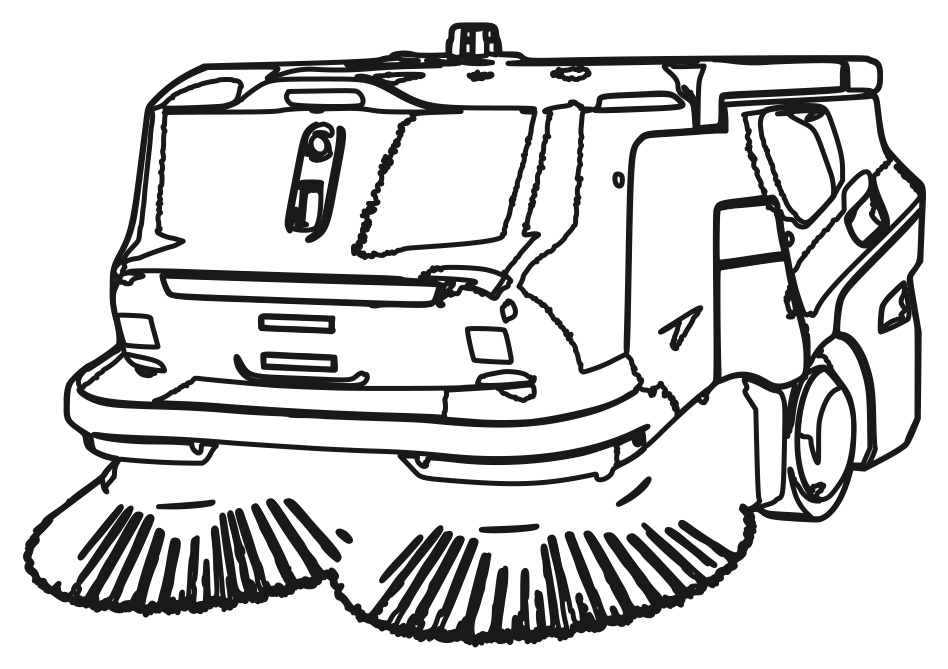
Adlatus does not sell a robot, it sells a system: the datasheet is titled "SR1300 + S1300 — sweeping-vacuum robot system with service station", and the station is the point. Mechanically the robot itself is conventional and, in the best sense, unspectacular. A height-adjustable roller brush moves debris into a 115-litre hopper, one or two side brushes feed dirt inward from corners and edges and are then raised and switched off again so they do not stir up dust unnecessarily, and the airflow pulls the raised dust through a class-M filter — a 5.5 m² pocket filter as standard, or a 6.4 m² cartridge filter which Adlatus recommends only for light dust because it clogs quickly, but which tolerates floors where moisture occurs. The filter is cleaned by automated shaking, integrated into the software. There is no water anywhere in this machine and no scrubbing function: it sweeps and vacuums, and the floor behind it is dry and immediately driveable. Anything that adheres — tyre marks, dried spills, grease film — needs a scrubber, and on sites that have both problems the sequence is sweep first, scrub afterwards.

The manufacturer is ADLATUS Robotics GmbH, Nicolaus-Otto-Straße 4 in 89079 Ulm; the datasheet states that the company develops, produces and sells service robots, and the back page of the current brochure carries the note "Made in Germany". That is the manufacturer’s own current claim and we report it as such — where the components come from is not verifiable from the outside, for this or for any other manufacturer. Since September 2025 Adlatus has been in a strategic partnership with NEURA Robotics from Metzingen, explicitly a partnership and not a disclosed acquisition; Adlatus states it gains increased production capacity, international reach and technological complementarity from it. No financial or equity terms were published, which is worth remembering when you are signing a multi-year commitment. The system is shipping and actively marketed: the current datasheet is dated September 2025, and in February 2026 the trade press reported the SR1300 at LogiMAT 2026 in Stuttgart, hall 10, booth 10C58.
02

The verified figures — and where Adlatus’ own sources contradict each other

From the official datasheet v3.0 of September 2025, which we extracted and read in full: 800 mm cleaning width with the main brush alone, 1,163 mm with one side brush, 1,271 mm with two, a maximum theoretical cleaning performance of 5,000 m²/h, a 115-litre hopper, 5.5 m² pocket or 6.4 m² cartridge filters in class M, a 24 V system with 2.63 kW maximum installed power, front drive, 1.11 m/s maximum forward speed (4 km/h), 20 % maximum negotiable gradient (11.3°), 3,000 mm minimum distance between two walls for a U-turn, three to eight batteries from roughly 180 Ah up to 480 Ah, five hours charging time in the standard configuration and 2.5 hours with the double charging fit-out. The official product pages add a maximum reverse speed of 0.03 m/s, which the v3.0 table no longer lists. The datasheet states CE certification for the system and collision avoidance at performance level D per EN IEC 63327. Officially targeted applications are industry and production, logistics, public facilities, shopping arcades and car parks.

The first number worth reading carefully is the area performance, and Adlatus makes that easy by labelling it "theoretical" itself. Multiply the maximum working width of 1.271 m by the top speed of 4 km/h and you get about 5,084 m²/h — so the published 5,000 m²/h is essentially the geometric ceiling, the area the machine would cover driving straight ahead with no turns, no overlap and no obstacles. That is a legitimate way to publish a figure as long as everyone knows it, but it makes cross-manufacturer comparison misleading. Our MT1 Max is rated at 2,200 m²/h against a ceiling of about 3,024 — roughly 73 % of its geometric maximum, where Adlatus publishes about 98 % of its own. Putting 5,000 next to 2,200 therefore does not compare two machines, it compares two publishing conventions; how these figures come about across the class is the subject of our sweeping-robot comparison.

Now the contradictions, and they are Adlatus’ own. Dimensions: datasheet v3.0 states 1,700 × 1,300 × 1,500 mm, the current official product pages in German and English state 1,163 × 1,003 × 1,506 mm, and the superseded datasheet v1.0 of May 2022 states 1,700 × 1,010 × 1,300 mm. We follow v3.0, for two checkable reasons: the "length" of 1,163 mm on the web pages is exactly the machine’s cleaning width with one side brush, which reads like a transcription error in the content management system, and a Swiss dealer independently lists 170 × 130 × 150 cm, matching the datasheet. Weight: v3.0 says 485 kg in standard fit-out, the web pages say 448 kg without batteries, v1.0 said 375 kg without batteries — note that these are measured differently, and on a machine carrying between three and eight batteries the weight is a configuration value by nature, not a constant. Working width: v3.0 and both web pages agree on 800/1,163/1,271 mm, v1.0 stated 800/1,050/1,300 mm, and a dealer page circulates a "working width of 1,570 mm" that appears in no Adlatus document and would exceed the machine’s own width of 1,300 mm. Do not put 1,570 mm in a tender. Two further values simply changed with the document generation: v1.0 stated a theoretical 9,100 m²/h, which overshoots even its own geometric ceiling of about 5,200 m²/h at the same 4 km/h drive and was corrected to 5,000 in v3.0, and a press carry from 2023 still circulates 1.2 m/s where every official Adlatus document since 2022 has stated 1.11.

The runtime deserves the same care. The official "up to eight hours" belongs, in the datasheet’s own sentence, to the full expansion to eight batteries and 480 Ah. For the standard version Adlatus specifies approximately 180 Ah and publishes no runtime at all. A Swiss dealer lists up to 2.5 hours per charge for the standard version — that figure appears in no official Adlatus document, but it is consistent with the manufacturer’s own numbers, because 180 of 480 Ah scaled linearly against eight hours lands at around three. The practical consequence is the one that matters: the 8-hour figure and the 2.5-hour figure do not describe a conflict, they describe two different machines, and nobody should plan a shift against either without the battery count in writing. Finally, what Adlatus does not publish anywhere: no dB(A) value in the datasheets, on the product pages or at the dealers, no suction figure in pascal, no battery chemistry and no IP rating — which is why car parks appear as an official target industry but covered decks are the only defensible reading.

03

The S1300 station: the part that actually distinguishes this system

Of the six autonomous sweeping robots we examined for our sweeping-robot comparison, five dock and charge on their own — and on every one of them except this system, a person still walks over, pulls the hopper and carries it to a bin. That step is the reason night shifts are not actually unattended, and the S1300 is built to remove it. The station charges the batteries inductively, without a plug, and empties the 115-litre hopper automatically: an automated high discharge lifts the debris up to 1,450 mm off the ground and tips it into a standard DIN EN 840 waste container of 1,100 litres — the containers that are already standing in every logistics yard in Germany. The whole procedure runs inside a fenced safety zone monitored by sensors, and the datasheet describes the cleaning programmes as starting automatically at the station too, time-scheduled per weekday.

Among the six autonomous sweeping robots realistically available in Germany that we examined for our sweeping-robot comparison, the SR1300 is the only system where no human empties the hopper. That is the line between "autonomous" and "unattended", and it is the single feature that decides whether a night shift needs someone on site at all. Do the arithmetic against the hopper volumes rather than against the marketing: 115 litres is more than three times the 35 litres our MT1 and MT1 Max carry, and on top of that the Adlatus empties itself while the compact machines wait for a person. On a large site those two effects multiply.

The honest counterweight is that the station is a building decision, not a purchase decision. Per the datasheet the S1300 measures 3,500 × 2,000 × 2,000 mm and weighs around 240 kg, and next to it a 1,100-litre container has to stand permanently, inside a safety zone that must be kept clear. That is a fixed footprint someone has to allocate in a warehouse or production hall that is usually already full, plus a container that someone still has to swap when it is full — the loop is closed for the robot, not for the site. Commissioning matches that scale: Adlatus describes an installation project with site checklists, a feasibility assessment, setup defined according to floor condition and soiling, training, and ongoing project monitoring using the protocol data. This is a system you install, not a machine you unbox.

04

Navigation without cameras — privacy as a design decision

The second genuine differentiator is not a performance figure but an omission. Adlatus states in the datasheet that it is one of the few manufacturers deliberately doing without high-resolution cameras in navigation for data-protection reasons, and uses 2D and 3D lidar sensors instead, which record no personal data and register no environmental detail during operation — the environment is stored as coordinates only. The lidar set is what detects obstacles and persons and picks up ledges, level changes and steps early, and Adlatus certifies the resulting collision avoidance at performance level D per EN IEC 63327. In other words, the camera is not missing, it was designed out, and the safety function is carried by a different sensor class.

The second half of the same argument is the machine’s independence from your network. The datasheet states that operation is entirely self-contained and needs neither a WLAN connection nor a continuous internet connection, which is why Adlatus explicitly names prototype shops, public buildings and other security-sensitive environments as application areas. Anyone who has ever tried to get a cloud-connected cleaning robot past an IT department knows how much of a project timeline that can remove. Note the boundary honestly, though: privacy by design is Adlatus’ own description of its development approach, and the certified, GDPR-compliant cleaning protocol the machine emails after every run is a document about areas and times, not proof of anything else. Ask for the processing documentation before anyone relies on it in a works agreement — what actually matters in data protection for cleaning robots sorts the questions that belong in that conversation.

For a German buyer this is more relevant than it looks on a spec sheet. Camera-based robots regularly fail at the works council, at the data protection officer, or at the entrance to a hall where prototypes are standing — not because they are worse machines, but because nobody wants to litigate a camera on a factory floor. A machine that has no camera to argue about simply skips that conversation. That is a procurement advantage, and it is entirely independent of how many square metres per hour the thing manages.

05

Who it would be the right machine for — and when a compact sweeper covers the need

Three conditions have to come together for this system, and area size alone is not one of them. First, the area has to be large enough that a 35-litre hopper would need emptying several times a night — Adlatus states up to 45,000 m² in 24 hours for the system, which is a manufacturer claim with an "up to" in front of it rather than a measurement, but it does indicate the intended scale. Second, the shift really has to run unattended: if someone is on site anyway, the self-emptying station loses most of its value, because that person can empty a compact machine in two minutes. Third, the layout has to suit the machine — 3 metres between walls for a U-turn and a height of 1.5 metres are hard constraints, and 485 kg in standard fit-out is a floor-load question on a mezzanine, a ramp or an upper car park deck.

Where those three do not all apply, a compact dry sweeper covers the same cleaning job. The MT1 Max sweeps 700 mm wide at up to 2,200 m²/h with a 35-litre hopper and up to 10 hours of runtime, the MT1 does up to 1,800 m²/h with up to 8 hours, both are equally waterless, both dock and charge on their own, and both need a person for the hopper. For a single hall of a few thousand square metres with staff in the building, that is not a compromise — it is the appropriate machine, and it does not require anyone to find 7 m² of floor for a service station. Which class fits your building at all is the question our cleaning-robot class overview works through, floor type by floor type.

Two more boundaries belong on the table before anyone shortlists it. This is an industrial machine for warehouses, production, public facilities, shopping arcades and covered car parks, and Adlatus itself pitches operation outside working hours as the normal case. It is not an office, hotel or guest-area machine — not because we measured it as loud, but because nobody publishes a decibel figure and a 2.63 kW vacuum sweeper is not a machine you place next to sleeping guests on the strength of an assumption. And it sweeps: if your problem is adhesions, tyre marks or a greasy film rather than dust and debris, this is the wrong class of machine no matter how good the system is.

On commercial positioning we can only report what is verifiable, which is that nothing is. Adlatus publishes no list price, and the dealers quote on request; there are no rental rates in the public domain either. Through us the system is available in the same full-service model as the rest of our programme, and we quote no prices on this site either. That means any comparison you make will be quote-against-quote, and it means the deciding numbers are the ones nobody prints: the floor space the station occupies, who swaps the 1,100-litre container, what the installation project costs you in internal time, and what a service call is worth when this one machine covers a site of that size on its own.

MT1
MT1 Max
MT1compact dry sweeperMT1 Maxcompact dry sweeper
Pictograms: vectorized 1:1 from our product reference photos — not illustrative icons.
06

What to get in writing before you decide

Start with the numbers the documents contradict. Ask for the exact dimensions and the exact weight for the configuration being offered — mention that the datasheet and the website differ, and that the weight changes with the number of batteries; you need this for floor load, ramps and lift capacity, and it is the one figure a demo will not tell you. Then ask for the runtime for that same configuration, with the battery count stated, and remember that the eight hours belong to the maximum fit-out. Ask for the noise level as a measured value with the measurement condition attached, because no dB(A) figure has ever been published anywhere for this machine. Ask for the IP rating, especially if a car park is in scope. And ask for the EC declaration of conformity: the datasheet states the system is CE certified, so the document exists and should be handed over rather than assumed.

Then the questions about the system rather than the robot. Where exactly does the S1300 stand, who allocates the 3.5 by 2 metre footprint plus the safety zone, and does the installation need any fixed building work. Who swaps the 1,100-litre container when it is full, and how often will that be with your debris — nobody publishes how many square metres one 115-litre filling covers, for this or for any other sweeper, so the answer has to come from a measured run on your floor and not from a brochure. Clarify whether the machine is available at all without the station, since the current datasheet describes only the system of robot plus station. And ask what the commissioning project actually demands from your side: Adlatus describes checklists, a feasibility assessment, teach-in of the cleaning areas and training, and all of that is internal time somebody has to plan for.

Finally the commercial questions that outlive the machine. Ask what the NEURA Robotics partnership means in practice for spare-parts supply and support over a five-year term — it was announced as a partnership with no financial terms disclosed, which is not a criticism, just an unknown you should price in. Ask who specifically serves your postcode: Adlatus states weekday on-site service through an international network of partners and dealers, so have the actual partner named, along with a committed response time and where the spare parts for your machine physically sit. Those answers determine your uptime; the country on the back page does not. And if you would like this same list applied to your own floor, talk to us — including in the case where the honest answer is that the Adlatus system fits you better than the compact machines we run every day.

07

Frequent questions

The manufacturer is ADLATUS Robotics GmbH, based at Nicolaus-Otto-Strasse 4 in 89079 Ulm. The official datasheet states that the company develops, produces and sells service robots, and the back page of the current brochure from September 2025 carries the note "Made in Germany". That is the manufacturer's own current claim and we report it as exactly that — where the individual components come from is not verifiable from the outside, for this or for any other manufacturer. Since September 2025 Adlatus has been in a strategic partnership with NEURA Robotics from Metzingen, which is also in Germany; Adlatus states it gains increased production capacity, international reach and technological complementarity from it. It was announced as a partnership, not as an acquisition, and no financial terms were published.

Dry only. A height-adjustable roller brush moves debris into a 115-litre hopper, one or two side brushes feed dirt in from corners and edges, and the airflow pulls the raised dust through a class-M filter — a 5.5 square metre pocket filter as standard or a 6.4 square metre cartridge filter, cleaned by automated shaking. There is no water, no chemistry and no scrubbing function anywhere in this machine, so anything that adheres to the floor stays there: tyre marks, dried spills and grease film need a scrubber-dryer instead. The cartridge filter does tolerate environments where moisture occurs on the floor, but that describes the floor, not the machine — the trace the SR1300 leaves behind is dry and immediately driveable.

That depends entirely on how many batteries are fitted, and the published figures are easy to misread. The official datasheet states up to eight hours — but in its own sentence that belongs to the full expansion to eight batteries and 480 Ah. For the standard version Adlatus specifies approximately 180 Ah and publishes no runtime at all. A Swiss dealer lists up to 2.5 hours per charge for the standard version; that figure appears in no official Adlatus document, but it is consistent with the manufacturer's own numbers, since 180 of 480 Ah scaled linearly against eight hours lands at around three. So the two figures do not contradict each other, they describe two different configurations. Charging takes five hours in the standard configuration and 2.5 hours with the double charging fit-out, and at the service station it happens inductively, without a plug.

It closes the loop that every other sweeping robot leaves open. The S1300 charges the batteries inductively and empties the 115-litre hopper automatically: an automated high discharge lifts the debris up to 1,450 millimetres off the ground and tips it into a standard DIN EN 840 waste container of 1,100 litres. The whole procedure runs inside a fenced safety zone monitored by sensors, and cleaning programmes start from the station on a weekday schedule. Among the six autonomous sweeping robots realistically available in Germany that we examined, this is the only system where no person empties the hopper — which is the actual difference between autonomous and unattended operation. What it takes in return is floor space: the station measures 3,500 by 2,000 by 2,000 millimetres, weighs around 240 kilograms, and a 1,100-litre container has to stand next to it permanently.

Neither. Adlatus states in its datasheet that it is one of the few manufacturers deliberately doing without high-resolution cameras in navigation for data-protection reasons, using 2D and 3D lidar sensors instead which record no personal data and register no environmental detail during operation — the environment is stored as coordinates only. The same lidar set detects obstacles and persons and picks up ledges, level changes and steps early, and Adlatus certifies the resulting collision avoidance at performance level D per EN IEC 63327. Operation is also entirely self-contained: the datasheet states that no WLAN connection and no continuous internet connection are required, which is why Adlatus names prototype shops, public buildings and other security-sensitive environments as application areas. Privacy by design is the manufacturer's own description of its approach, so ask for the processing documentation before relying on it in a works agreement.

See it instead of reading?

We show you the machines in 30 minutes at your site — free and non-binding.

Request a demo
Adlatus SR1300View machine →Pudu MT1 MaxView machine →Pudu MT1View machine →