
Knowledge

Market overview · · 10 min read

Kemaro K700 Compact: 25 cm Tall, and What Kemaro Does Not Publish

The Kemaro K700 Compact is 25 cm tall, and that number is the entire product. Before anything else: what follows is a documentation-based assessment. We read the official factsheet ourselves in both the English and the German edition, checked the manufacturer product pages in both languages, and traced every figure back to its source. The result splits in two. The core specifications of the K700 are cleanly documented and easy to verify. Next to them sits an unusually long list of things Kemaro simply does not publish for this machine, from the charging solution to the filter class. Both belong in the same assessment, because with this robot the gaps decide more than the specs do.

Key takeaways

  • Official factsheet: 750 m²/h, 70 cm sweeping width, 11-litre hopper, up to 4 hours of runtime, under 25 kg, 76 × 62 × 25 cm — dry only, no water and no chemicals anywhere in the machine.
  • The 25 cm height is the reason the machine exists: under low racking, under machines, under conveyors. Our MT1 measures 49 cm, the larger K900 measures 35 cm.
  • Kemaro publishes no charging or docking solution for the K700, no filter class and no K700-specific certifications — all three are documented for the K900. A noise value is missing for both machines, and so is the battery capacity of the current Gen II.
  • Kemaro’s own blog says the K700 keeps "the same cleaning power as the K900". The two factsheets say 750 versus 1,000 m²/h and 70 versus 90 cm. The factsheet wins.
01

What the K700 Compact is — and what we are able to say about it

Once more, plainly, because it governs how you should read everything below: every figure here comes from KEMARO AG’s own documents, which we read at the source instead of copying from a dealer page. Where the manufacturer claims something we cannot check, we mark it as a manufacturer claim and leave it at that.

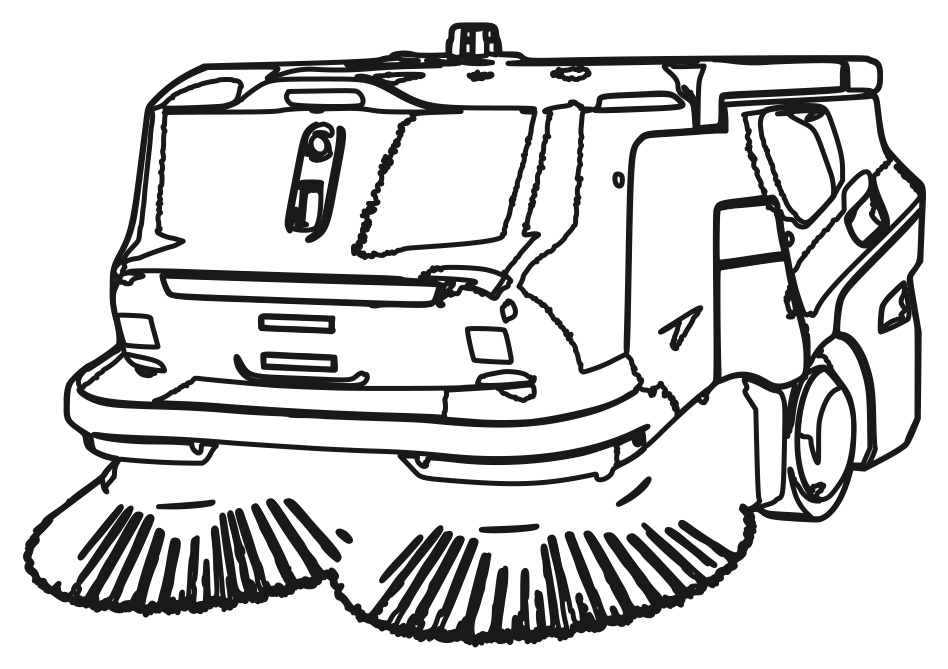
Mechanically the K700 Compact is an autonomous industrial dry sweeping robot from KEMARO AG in Eschlikon, Switzerland, and it is deliberately simple. Brushes move debris into the machine while a blower puts the housing under negative pressure and draws the airborne dust through an air filter of around 2 m² into an 11-litre hopper. The factsheet rates the largest piece it will take as a cylinder of 35 × 100 mm — roughly a piece of packaging waste, not a block of wood. There is no water and no chemistry at any point in this machine, which is exactly how Kemaro positions it: no chemicals, no water, no lighting needed, suited to packaged goods and sensitive dry areas. The floor behind it is dry and immediately walkable and drivable. What it will not do follows from the same mechanism: no stains, no adhesions, no tyre marks, no liquids, no carpet. It removes loose debris and dust, and that is the whole job.

The lifecycle matters as much as the mechanism here. Kemaro unveiled the K700 as a "sneak peek" at Logistics & Automation in Madrid on 15 and 16 October 2025. In its Series-B press release the company states that the machine "is already seeing high pre-order volumes", which is a pre-order statement rather than a shipping statement. In mid-2026 Kemaro brought its DACH dealers in for hands-on K700 training, announced on its own LinkedIn channel. When we researched this in August 2026, we checked the German dealers who sell the K900 and found none of them listing the K700. So: the specifications are final and official, the machine is real, and delivery capability for Germany is the thing you get confirmed in writing before you plan a site around it.
02

The 25 cm are the product — and where they stop

Kemaro states the design premise in the first sentence of the factsheet: with an extremely low height of only 25 cm and a reduced diameter, the K700 Compact was designed to access areas that were previously unreachable — cleaning under low shelves, machines or other tight spaces. The rest of the sheet follows from that. The machine measures 76 × 62 × 25 cm and weighs under 25 kg, which means one person can pick it up and carry it to the next zone. Kemaro also states that it turns within a single pallet space, and that no installation is necessary: put it in place and clean.

To see how flat 25 cm actually is, compare it with the machines we run ourselves. Our MT1 measures 840 × 600 × 490 mm per the official Pudu spec sheet, so it is nearly twice as tall; the MT1 Max is 675 mm. Kemaro’s own larger model, the K900 Gen II, is 35 cm. Under a conveyor at 30 cm or on the bottom shelf of a low rack, the K700 is the only one of these machines that goes in at all. A second dimension is worth reading carefully, because the word "Compact" invites an assumption that does not hold. The K700 is narrower than the K900 — 62 against 72 cm, which is the reduced diameter Kemaro advertises — but it is not narrower than our MT1, which is 60 cm wide. Its compactness sits in height and length, not in width. And where Pudu specifies a minimum path clearance of 75 cm for the MT1, Kemaro publishes no minimum clearance figure for the K700 at all, so how narrow an aisle it will actually commit to is a question for the vendor rather than something you can read off the sheet.

Now the limit, because "previously unreachable" is a height statement and not a magic one. Under-rack is not under-pallet: a pallet standing flat on the floor is lower than this robot, and the pallet Kemaro places next to the two machines in its own factsheet diagram is a size reference, not a gap the K700 drives through. Whatever it reaches under the racking, it still cleans dry — it will pull out dust, packaging debris and pallet abrasion, and it will leave anything stuck to the floor exactly where it is. And the 12 % maximum ramp slope from the factsheet applies down there too.

The remaining hardware is the same feature set Kemaro sells on the K900 and labels on the K700 sheet as trusted features as the K900: autonomous navigation with live mapping and localisation, a 2D LiDAR "crown" measuring distances across 270 degrees plus a 3D sensor for the lower blind spots and small objects, the patented self-cleaning Automatic Filter Cleaner, Connected Rooms for moving autonomously between rooms, and the BlueSpot, a blue light projected onto the floor to warn staff and forklift drivers — explicitly including under conveyor systems. That last one tells you the intended environment more precisely than any brochure line: this machine is built to work among forklifts.

03

What Kemaro does not publish for the K700 — and why it matters

Start with the one that decides the operating model: charging. For the K900, Kemaro documents a docking station with an 85–240 V input, coverage of up to 20,000 m² per station and scaling to 100,000 m² with several stations. For the K700 there is nothing. Not on the factsheet, which we read in full in both language versions, not on the English product page and not on the German one — we checked all four documents for it. Whether the K700 uses the same dock, gets its own, or is simply charged by hand is unpublished. That is not a footnote in a spec table. It is the difference between a robot that works a night shift on its own and one that needs somebody to plug it in, and with 4 hours of runtime against 90 minutes of charging time it determines how many cycles you actually get.

Second: the filter class. Both factsheets specify an air filter of around 2 m². Only for the K900 does Kemaro publish what that filter actually holds back — its own blog states that the filter of the K900 is class "M" and particularly suitable for industrial dirt. That article is about the K900 throughout. For the K700, no filter class appears anywhere. If your dust is wood, metal or mineral, the class is not a detail, it is the entire question, and the sibling machine having class M is not evidence about this one.

The list continues, and it is worth going through in one piece. There is no noise value — Kemaro publishes no decibel figure for the K700 or for the K900, in no document. There is no pascal figure for suction, which is defensible given the mechanism is negative-pressure dust extraction rather than household vacuuming, but it does mean there is no number to compare. The battery is given as lithium-ion 36 V with no capacity in ampere-hours or watt-hours. IP54 protection and the battery and charger standards EN 62133-2:2017 and IEC 60335-1 and -2-29 do appear in Kemaro’s official FAQ, but that FAQ answers for the K900 — we verified that at the source, and it means none of those values is confirmed for the K700. We found no CE documentation for the K700 anywhere public. VDA5050 compatibility for AGV fleet management is stated for the K900 Gen II and not for the K700. And unlike the K900 with its ECO, SMART, TOP and K-Integrated tiers, no variant structure is published for the K700 at all.

Two more items belong in the honest column. Kemaro’s blog post about the Madrid unveiling describes the K700 as "a more compact model … but maintaining the same cleaning power as the K900". Kemaro’s own two factsheets contradict that: 750 against 1,000 m²/h, 70 against 90 cm sweeping width, 11 against 35 litres. The factsheet is the more recent and more specific document, so it wins, and the blog line should never make it into a calculation. The K700 factsheet also carries the marketing line that the machine saves businesses up to 50 % of cleaning costs per year, with no methodology attached anywhere on the sheet or the site. That is a manufacturer claim, not a measurement, and it has no place in a business case. While we are at it: multiplying 4 hours by 750 m²/h to arrive at 3,000 m² is arithmetic, not a specification, and Kemaro publishes no area-per-charge value.

04

Placed against the MT1 and against the K900

The K700 and our MT1 share exactly one number, and it is a misleading one: both sweep 70 cm wide. Everything else diverges. The MT1 is rated at up to 1,800 m²/h in standard cleaning mode with a 35-litre bin and a cruise speed adjustable between 0.2 and 1.2 m/s; the K700 does 750 m²/h at a fixed 0.7 m/s with 11 litres. These are not two candidates for the same job. The MT1 is a large-area machine that needs 75 cm of clear path, the K700 is an access machine that fits where the MT1 physically cannot go.

And the throughput gap is smaller than it looks, for a reason worth understanding before anyone builds a table out of it. Take the K700’s own geometry: 0.7 m/s across 70 cm is about 1,760 m²/h in a straight line with no turns, no overlap and no obstacles. Kemaro publishes 750, which is roughly 43 % of that — in other words Kemaro is quoting a realistic coverage figure with the losses already deducted. Pudu’s 1,800 m²/h is stated as a maximum for the standard cleaning mode. Those two numbers are not measured the same way, and putting them side by side without saying so misleads in our favour. How area-performance figures come about in general is the subject of our sweeping-robot comparison; the honest short version is that nobody can size the real gap without running both machines on the same floor.

Against its own larger sibling the picture is cleaner, because both figures come from the same manufacturer measured the same way. The K900 Gen II does 1,000 m²/h at 90 cm width, 35 litres, 32 kg, 79 × 72 × 35 cm. The K700 does 750 m²/h at 70 cm, 11 litres, under 25 kg, 76 × 62 × 25 cm. Identical on both sheets: 0.7 m/s, up to 4 hours of runtime, 90 minutes of charging, lithium-ion 36 V, 12 % maximum ramp. So the K700 is not simply a smaller K900: it is a flatter and narrower one that gives up throughput and hopper volume in exchange for access, and that access is the only good reason to choose it. Our separate market overview of the K900 Gen II goes through the larger machine in detail, including the runtime contradiction in Kemaro’s own sources that affects both models.

If you take away one operational number from this comparison, make it the hopper. Eleven litres against 35 on the K900 and 35 on the MT1 is not a specification detail, it is your staffing model: it sets how often somebody has to walk over, pull the machine out from under the racking and empty it. In a dusty hall that frequency, not the square metres per hour, is what determines whether the robot saves labour or relocates it.

MT1
MT1 Max
MT149 cm tallMT1 Max67.5 cm tall
The dry sweepers in our own fleet, for scale — the K700 Compact is 25 cm. Pictograms: vectorized 1:1 from our product reference photos, not illustrative icons.
05

Where it belongs — and the list to take into the demo

The K700 belongs on a shortlist when you have a specific, physical problem: dust and loose debris on hard floors in places a normal machine cannot get into. In warehouses and logistics sites that means the bottom level of low racking, the strip under conveyor lines and the narrow aisles between blocks; in production it means under and between machines, where dust settles undisturbed for months because nobody can reach it with a scrubber or a ride-on. Kemaro names its own application areas on the K700 sheet as large warehouses and factories, logistics centres and production facilities — noticeably narrower than the K900 sheet, which additionally lists bottling plants, railway stations and car parks. Hazardous-materials storage is not one of those additions — it sits on the target-industry list for both machines. That narrowing is the manufacturer telling you what the machine is for, and it is worth taking literally.

It does not belong anywhere near offices, retail floors during opening hours, or guests and quiet zones. Not because we measured it as loud — we did not measure anything, and nobody publishes a decibel value — but precisely because of that: this is a blower-driven industrial machine that the manufacturer positions for halls, and committing to noise levels without a number is how projects go wrong. It is equally out for liquids, for carpet, and for ramps above 12 %. And if your actual problem is adhesions, tyre marks or sticky floors rather than dust, no sweeper solves it; you need a scrubber, and which cleaning robot fits which operation sorts that question by floor type and soiling before anyone books a demonstration.

For the demonstration itself, the useful list is not the spec sheet — that part is already verified. It is the list of things Kemaro does not publish, turned into questions. How is this machine charged, is there a docking station for it, and what area does one station cover? What is the filter class, and what is the service interval for the filter with dust like ours? What is the noise level in dB(A), and under what measurement conditions? Is there an EC declaration of conformity for the K700 specifically, and does the IP54 rating from the FAQ apply to this model? What is the battery capacity in watt-hours? What is the minimum aisle width the robot will commit to? Is the Sphere cloud scope identical to the K900 — the K700 sheet points to the K900 feature set without itemising the platform. And in writing: is the machine deliverable in Germany today, who services it, and where do the spare parts sit?

Then measure the two things that decide the case and appear on no data sheet. How often does the 11-litre hopper need emptying with your dust, not with a demonstration floor’s dust — and who does it, given the machine may be sitting under a rack when it fills up. And how much area does it actually cover per charge in your layout, with your racking and your obstacles. If you would like that list applied to your own floor, talk to us. You will get the honest answer plainly — including in the case where the honest answer is that a flat Kemaro fits your building better.

06

Frequent questions

The official factsheet gives a build height of 25 cm, with overall dimensions of 76 by 62 cm and a weight under 25 kg. Kemaro designed it to clean under low shelves, under machines and in tight spaces, and its BlueSpot safety light is described as working under conveyor systems as well. For scale: the larger K900 Gen II is 35 cm tall and the Pudu MT1 we operate is 49 cm. One limit is worth stating clearly — a pallet standing flat on the floor is lower than the robot, so under-rack access does not mean under-pallet access. Kemaro publishes no minimum aisle width for the K700, so ask for that figure separately.

Dry only, with no water and no chemicals in the machine at all. Brushes move debris inwards while a blower puts the housing under negative pressure and pulls the dust through an air filter of around 2 m² into an 11-litre hopper; the largest piece it takes is specified as a cylinder of 35 by 100 mm. That means it removes loose debris and dust but not stains, adhesions, tyre marks or liquids, and it is not a carpet machine. The floor behind it is dry and immediately walkable and drivable. Note that Kemaro publishes a filter class only for the larger K900, where the company states class M — for the K700 no filter class is published anywhere.

Kemaro does not publish one. We checked the official factsheet in both language versions and both the English and the German product page, and none of them mentions a docking or charging station for the K700 — while the K900 Gen II has one documented, including an 85 to 240 volt input and coverage of up to 20,000 square metres per station. Whether the K700 shares that dock, gets its own, or is charged manually is an open question. It matters more than it sounds: the factsheet states up to 4 hours of runtime and 90 minutes of charging time, so how the machine gets back to power decides whether it runs a shift unattended. Ask before you plan around it.

No, and Kemaro’s own sources disagree here. A Kemaro blog post about the 2025 unveiling in Madrid describes the K700 as a more compact model maintaining the same cleaning power as the K900. The two official factsheets say otherwise: 750 versus 1,000 square metres per hour, 70 versus 90 centimetres of sweeping width, an 11-litre versus a 35-litre hopper. We publish the factsheet figures, because they are the more recent and more specific documents. What genuinely is identical on both sheets is the rest of the drivetrain: 0.7 metres per second, up to 4 hours of runtime, 90 minutes of charging, lithium-ion at 36 volts and a maximum ramp slope of 12 per cent. The K700 trades throughput and hopper volume for access.

That is exactly the question to put in writing. The machine was unveiled at Logistics & Automation in Madrid on 15 and 16 October 2025, Kemaro stated in its Series-B press release that it was already seeing high pre-order volumes ahead of market launch, and in mid-2026 the company trained its DACH dealers on the K700. But when we researched this in August 2026, none of the German dealers who sell the K900 listed the K700, and Kemaro publishes no variant structure for it. The specifications are final and the official factsheets exist in German as well as English, so the machine is real and documented. Delivery capability and service coverage for Germany are the parts you should have confirmed by Kemaro or a dealer before planning a site around it.

See it instead of reading?

We show you the machines in 30 minutes at your site — free and non-binding.

Request a demo
Pudu MT1View machine →Pudu MT1 MaxView machine →