Knowledge

Machine profile · · 13 min read

Adlatus CR700C and CR700D: A Market Overview of the Scrubber-Dryer from Ulm

The Adlatus CR700 turns up regularly in tenders for industrial and logistics floors, usually as the German alternative to Asian scrubber-dryers. So the important part first: the CR700 is available through our programme and newly onboarded there. What follows is a documentation-based assessment — the official CR700C and CR700D brochures in their 09/2025 versions, the older brochure generations, the official product page and the manufacturer announcements, every figure read by us at the source rather than taken from a dealer page. What no document settles is how this machine behaves in its third year of service. What we can do is read the published figures carefully, name the places where the brochure does not carry, and place the CR700 honestly against the scrubber-dryers we rent out every day.

Key takeaways

  • The CR700 is available through us but newly onboarded, so every figure here comes from Adlatus documentation rather than from our own fleet. CR700C and CR700D are one platform with two brush decks: 260 kg, 700 mm cleaning width, 60 l fresh and 55 l waste water, 4 to 6 hours per charge — identical on both.
  • The C runs two roller brushes at up to 550 rpm and picks up coarse dirt into an on-board container while wet-scrubbing; the D runs two 330 mm disc brushes or pads at up to 140 rpm for smooth and delicate floors.
  • The headline 2,750 m²/h is labelled theoretical by Adlatus itself and equals width times top speed; the manufacturer’s own worked example comes out at roughly 2,500 m²/h — and that is still not a measurement.
  • No noise figure exists in any Adlatus source, and the CR700D data sheet prints an implausible "38 bar" contact pressure — neither is a number we use. The "only camera-free manufacturer" superlative appears solely in the superseded 02/2024 brochure; the current documentation says "one of the few" instead, which is a correction worth crediting.
01

What the CR700 is — and what we can and cannot say about it

Plainly first, because it decides how you should read everything below: the CR700 is available through our programme and newly onboarded there. Every figure in this article comes from ADLATUS Robotics GmbH’s own documentation — the CR700C brochure in version 4.0 (09/2025) and the CR700D brochure in version 2.0 (09/2025), both of which we read in full, plus the legacy brochure from 03/2020, the official product page and the manufacturer’s own announcement of its Neura partnership. No dealer pages, no comparison portals. Where the manufacturer claims something we cannot check, it appears here as a manufacturer claim and nothing more.

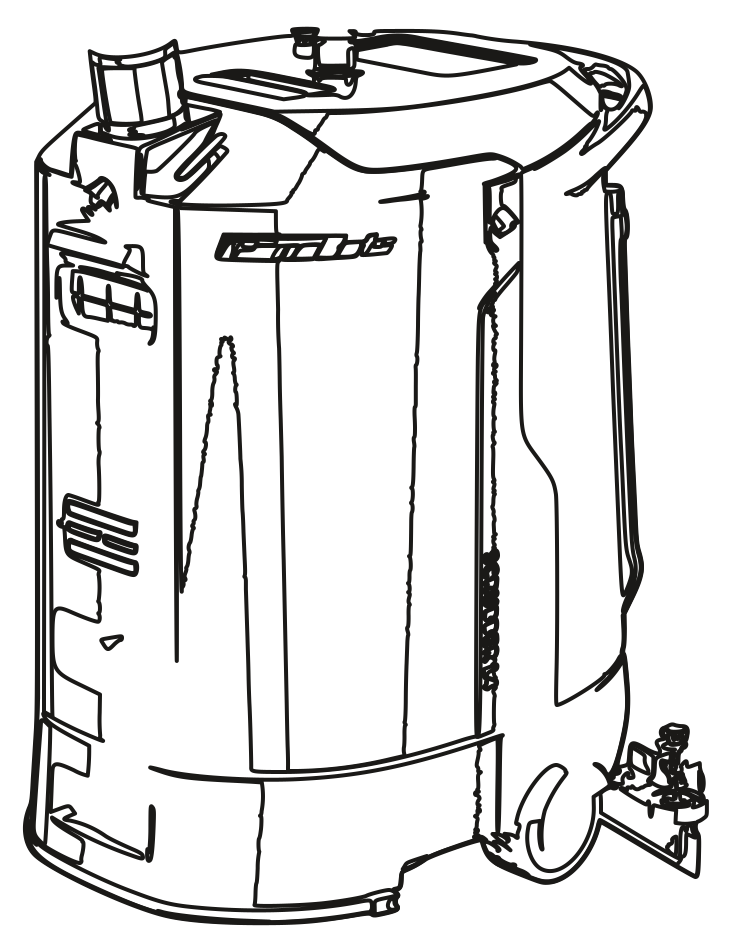
The CR700 is an autonomous scrubber-dryer built by a manufacturer in Ulm, and it cleans wet. It doses water and detergent onto the floor, scrubs, and pulls the dirty liquid back up behind it with a squeegee. What it leaves is a thin glossy film that dries within minutes — the same floor appearance as our CenoBots machines, never the dry finish of a sweeper. The platform figures from both brochures: 700 mm cleaning width and 750 mm pick-up width plus a side brush, a 60-litre fresh water tank, a 55-litre waste water tank and a 2-litre detergent container, each with fully automatic dosing during cleaning; 260 kg maximum weight; 827 × 1,267 × 1,067 mm (W × L × H); lithium-ion batteries in a 120 Ah or a 180 Ah option; 4 to 6 hours of cleaning per charge depending on battery option and cleaning intensity; 1.5 to 2.5 hours of speed charging; up to 4 km/h, individually adjustable.

The more interesting part is not the robot but the system. The optional S700-2 service station — the brochure product-details table lists it as optional, which matters, because the full-autonomy story is a configuration and not the base machine — charges the battery, refills fresh water, drains the waste water tank, and starts cleaning programmes on a stored schedule on any day of the week. Adlatus states approximately 70 kg for the station at 980 × 345 × 911 mm, charging in 1.5 to 2.5 hours, fresh water in under 10 minutes and waste water in under 5 minutes. It needs a 3/4" water connection at a minimum of 3 to 6 bar, secured by an aquastop valve the station can close itself, and a 230 V socket. Alongside the autonomous mode there is a manual one: for spontaneous spot cleaning the robot can be steered to a location using a mobile device. And the whole system is stated to run completely without Wi-Fi or a permanent internet connection, which Adlatus positions for safety-critical environments such as prototype construction and public buildings.

On lifecycle, the machine is current rather than announced. Both brochures carry the September 2025 version stamp, and a February 2026 trade press release places Adlatus at LogiMAT 2026 in hall 10, booth 10C58, showing the CR700C/D alongside the SR1300, the dry machine in the same programme, which we cover in its own article. One thing to be precise about: since September 2025 Adlatus has a strategic partnership with NEURA Robotics, and the current brochures and robot livery carry the joint branding. The manufacturer’s own announcement describes a partnership between two companies, not an acquisition — so anyone entering a commercial relationship should clarify in writing who contracts, who services the machine, and what the brand roadmap is.

02

C or D: the same robot, two brush decks

Adlatus sells the CR700 as one product line with two variants, and the two brochures make clear how far that goes. Cleaning width, pick-up width, side brush, tanks, detergent container, battery options, runtime, charging time, speed, the theoretical area figure, weight, dimensions, sensors, software, safety standard and the S700-2 station are word-for-word identical in both documents. The entire difference is the brush deck — and it is a difference that decides which floors the machine belongs on.

The CR700C runs two roller brushes, 180 mm in diameter and 656 mm long, at up to 550 rpm. Its distinguishing feature is not the brush type but what it does with loose dirt: the roller movement transports coarse particles into an on-board collection container while the machine wet-scrubs, so — in the manufacturer’s framing — the time-consuming pre-sweeping is eliminated. Adlatus positions the roller deck for structured and uneven floors and for surfaces with joints and cracks where dirt gets stuck. Worth noting for the demo: the volume of that collection container is not published anywhere, and it is the container someone on your site has to empty regularly.

The CR700D runs two disc brushes or pads, 330 mm in diameter, at up to 140 rpm — a quarter of the roller speed. The point of this deck is consumable flexibility: brushes clean deep into pores and grouting, pads allow gentle care of delicate floors, and the machine is adapted to tiles, concrete, PVC or natural stone by choosing the right brush or pad. There is no coarse-dirt pick-up in the D’s description, so loose debris remains a pre-sweeping job.

Two warnings about sources, both of which we hit ourselves. First, the D brochure’s prose praises "the high speed of the disc brushes" while its own spec table on the following page states max. 140 rpm, and the same brochure’s edge-cleaning paragraph describes roller brushes carrying dirt into a collection container — text carried over from the C document. Second, dealer copy for this machine is unreliable: at least one German dealer page describes the CR700C, the roller machine, as a disc-brush machine. Read the official spec tables, which are unambiguous, and ignore everything else.

03

The verified figures — and where the brochure does not carry

Start with the number everyone quotes. Both brochures state 2,750 m²/h under the heading "Cleaning performance (theoretical)", with the qualifier "depending on the environment and cleaning intensity". Do the arithmetic and you can see where it comes from: 4 km/h is 1.11 m/s, multiplied by the 700 mm cleaning width that is about 2,800 m²/h. In other words, the headline figure is essentially the geometric ceiling at top speed, with nothing deducted for turning, overlap, obstacles or refills — which is exactly why Adlatus labels it theoretical, and to its credit it does so in the spec table itself. The same brochures give a worked example: with roughly 4 hours of average operation the machine can theoretically clean about 10,000 m² per battery charge. That works out at roughly 2,500 m²/h, and the manufacturer calls that theoretical too. Plan with the lower number, and treat even that as a ceiling rather than a coverage figure.

Just as important is what Adlatus does not publish. There is no noise figure anywhere — not in the 09/2025 brochures, not in the 02/2024 or 03/2020 generations, not on the product page. Dealer marketing calls the machine quiet without ever giving a number, and we will not reproduce a number that does not exist. There is likewise no gradient or ramp capability, no IP rating, no squeegee width, no battery voltage or watt-hour figure behind the 120 and 180 Ah options, and no volume for the C’s coarse-dirt container. A pascal figure for suction is genuinely absent rather than withheld: this is a squeegee machine, not a vacuum, and no such figure exists for it.

Then there is a value that is published and should not be used. The CR700D spec table lists the disc brushes as "2 pieces, 330 mm diameter, 38 bar contact pressure". 38 bar is roughly 550 psi; as a contact pressure under a floor-cleaning disc that is not physically plausible, and the most likely explanation is a unit error in the official PDF. We print it here only to flag it: it is not a figure we would carry into a specification, and it does not belong in a tender either. For orientation on what the figure should look like: the scrubbers we operate state contact pressure in kilograms — 18 kg for the CenoBots L3, 27 kg for the walk-behind Pudu SH1. Ask Adlatus for the correct value and, more importantly, the correct unit.

One piece of infrastructure fine print belongs here too. The station’s stated connections are the 3/4" water supply at 3 to 6 bar and a 230 V socket — the brochure specifies where the water comes from, but not where the waste water goes. Given that the station drains the dirty water tank automatically, a drain has to be part of the installation, so clarify it before you pick a location. Adlatus itself treats siting as a project rather than a delivery: installation preparation with an assessment of the property, commissioning, training, project monitoring with log-data analysis, and service through an international network with on-site support, hotline and maintenance contracts.

04

Placed against the scrubber-dryers we run every day

The scrubber ladder we run ourselves has three autonomous rungs. The CC1 is the compact one at 700–1,000 m²/h with a 500 mm cleaning width and 15 litres of fresh and waste water each. The L4 sits in the middle at 1,944 m²/h, 450 mm working width, 38 litres of fresh water and 150 kg. The L50 is our hall machine: 2,200 m²/h, a 510 mm disc brush, 55 litres per tank, up to 6 hours of runtime, 220 kg, and 67 dB(A) on the manufacturer data sheet. The CR700 sits above all three in size class — 700 mm, 260 kg, 60 and 55 litres — and it is closest to the L50, which is the machine you would realistically be comparing it against.

Now the number comparison, and it is more honest than it first looks. CenoBots labels its area figures "Max. Theoretical Productivity", and the arithmetic confirms it: 0.51 m × 1.2 m/s gives the L50’s 2,203 m²/h, 0.45 m × 1.2 m/s gives the L4’s 1,944. Adlatus labels its 2,750 m²/h theoretical and arrives at it the same way. So for once you are comparing two numbers of the same kind, and the paper gap of roughly a quarter is simply a width-and-speed gap — 700 mm at 4 km/h against 510 mm at 1.2 m/s. Both figures are equally unreachable on a real floor. Pudu’s 700–1,000 m²/h for the CC1 is a band rather than a ceiling and is not comparable to either. How these figures come about, and what actually decides between machines in this class, is the subject of our scrubber-dryer guide.

Structurally, three things genuinely set the CR700 apart. The size class is the obvious one: 60 litres of fresh water and up to 6 hours of runtime is a different endurance envelope from anything we run. Camera-free lidar navigation is the second, and among our scrubbers it is a real difference — the L4 pairs its lidar with a depth camera, the L50 combines lidar with vision. The third is the C variant’s coarse-dirt pick-up during wet cleaning, which none of our scrubbers offers. What is not a differentiator, despite being marketed as one, is the station itself: automatic water exchange at the dock exists for the CC1 as well, and the L3 does it via its mobile WT3 tank. The Adlatus difference is the scale at which it comes together, not the concept.

What the machines we run daily have that the CR700 does not is less spectacular and more decisive. A published noise figure, for one — 67 dB(A) for the L50, below 70 dB for the CC1 — which is the difference between being able to plan a night shift next to occupied areas and having to ask. And the fact that we run them, know their failure modes and hold spare parts. That is not a data-sheet argument. It is the difference between a documented machine and a known one, and for the Adlatus this article can only give you the first.

CC1
L4
L50
CC1compactL4mid-sizeL50hall machine
Pictograms: vectorized 1:1 from our product reference photos — not illustrative icons.
05

German manufacturer, camera-free — what that angle is actually worth

Take the origin claim precisely, because precision is what protects you in a tender. The current CR700C and CR700D brochures both carry a "Made in Germany" mark in the footer. That is the manufacturer’s own claim and we repeat it as exactly that, attributed — not as our assessment. The more specific and more useful statement comes from the 03/2020 brochure, which reads: "The final assembly of our Service Robots takes place in Ulm / Baden-Wuerttemberg." Development and final assembly in Ulm is therefore well supported. Where the components come from is not documented: the brochures describe the sensor system as built in cooperation with sensor manufacturers, and say nothing about the origin of the lidar units. If country of origin matters to your procurement rules, ask for that breakdown in writing rather than relying on a footer badge.

The privacy position is the stronger part of the story, and it is documented rather than implied. Both brochures state the sensor suite as 2D and 3D laser sensors, acceleration sensors and cliff-detection sensors, and state explicitly that obstacles are recognised "without recording personal data or saving details of the surroundings. Only coordinates are recorded." Adlatus describes privacy by design under the GDPR with no personal or environment-related data collected, and fully automated, certified and data-protection-compliant logging after each run — cleaned area, time spent and more — for invoicing, performance records and audits. Add operation without Wi-Fi or a permanent internet connection, which removes an attack surface rather than merely documenting it. For a works council or a data protection officer that is a genuinely good starting position, and it is the same argument we make for camera-free machines in our own guide to data protection with cleaning robots.

One claim from this product line has a history worth telling, because the manufacturer appears to have corrected itself. The superseded CR700C brochure of 02/2024 stated that "ADLATUS is the only manufacturer that does not use high-resolution cameras for navigation for data protection reasons". As a market statement that was false: the Nexaro NR1700 in our own fleet navigates entirely without cameras, on a long-range laser distance sensor (LR-LDS) and what Nexaro calls AI-Mapping. What happened next is the interesting part. None of the three brochures we cite above — CR700C version 4.0, CR700D version 2.0 and the 03/2020 sheet — carries a camera claim at all, and the current data sheet for the sibling SR1300 (version 3.0) puts it a different way: Adlatus is now „einer von wenigen Herstellern, die bei der Navigation aus Datenschutzgründen auf hochauflösende Kameras verzichten" — one of the few, not the only one. That is a manufacturer walking back a superlative it could not support, and it is worth noting as such rather than holding against it. Camera-free is a real and verifiable property of the CR700. Being alone in it never was, and the plain fact underneath is worth more in a tender than the superlative was.

And the caveat that outweighs the country of origin: a privacy statement is a statement, not a contract, and geographic proximity is not a response time. Before anyone relies on either, ask for the data processing agreement, the list of subprocessors, where the reporting data is stored and what actually leaves the building when the system does send cleaning reports by email. Then ask for a committed response time, where the spare parts for your machine physically sit, who performs the maintenance, and — given the Neura partnership — who your contractual counterpart is for each of those answers. Those are the things that determine your uptime and your audit position. A flag in a brochure footer does not.

06

Which sites it fits — and what to check in the demo

Adlatus names its own fields of application, and they map cleanly onto the kind of sites this machine belongs on. For the CR700C: industry and production, logistics, public areas and facilities, car parks and shopping centres — so production halls with textured or jointed concrete, warehouses and logistics floors where loose debris is part of the day, and car parks. For the CR700D: industrial areas, shopping arcades, sports halls, office buildings, public facilities and car parks; the official product page additionally lists healthcare and retail for the disc variant. The rule of thumb behind those lists is simply the deck. Joints, texture and loose dirt point to the C, smooth or delicate surfaces and a need for pad flexibility point to the D.

Where it does not belong is just as clear. Anywhere near sleeping guests is out — not because we measured this machine as loud, but because no manufacturer noise figure exists at all and this is a 260 kg industrial machine that Adlatus itself positions for halls, car parks and public areas. Sites below a few thousand square metres are the wrong size class and belong to a CC1 or an L4 rather than a 700 mm machine with a plumbed station. And if the station is part of the plan, a site without a fixed water connection, a socket and a drain in a sensible position rules the concept out before the machine is even discussed. If you are not yet sure whether a scrubber-dryer is the right class for your floor at all, which cleaning robot fits which operation sorts that by floor type and soiling first.

For the demo, leave the brochure and take a list. Get the noise level in writing with the measurement condition attached. Get the correct contact-pressure value and unit for the CR700D. Ask for gradient capability, IP rating and squeegee width, none of which are published. Ask for the battery in watt-hours, not just 120 or 180 Ah, and for the runtime of the option actually being quoted. Ask for the volume of the C’s coarse-dirt container and how often it needs emptying. Ask for the EC declaration of conformity and the evidence behind EN IEC 63327 compliance. Clarify the station: water connection, socket, drain, who does the plumbing, and whether the station is included in what you are being offered. And ask who contracts and who services under the Neura partnership.

Then measure the two things that decide the business case and appear on no data sheet. First, how much area the machine actually covers per charge in your layout, with your racking, your obstacles and your refill stops — multiplying 2,750 m²/h by four hours is arithmetic, not a specification, and even Adlatus’s own example lands about ten per cent below its own headline figure. Second, for the C variant, how often that coarse-dirt container fills with your dirt rather than a demo floor’s, because that number sets the staffing requirement that full autonomy was supposed to remove. If you would like the same list applied to your own floor, talk to us — including in the case where the honest answer is that the Adlatus fits you better than the machines we already run every day.

07

Frequent questions

Wet. Both variants are scrubber-dryers: they dose water and detergent from a 60-litre fresh water tank and a 2-litre detergent container onto the floor, scrub it, and pull the dirty liquid back into a 55-litre waste water tank with a squeegee. What stays behind is a thin drying film, not a dry swept floor. The CR700C additionally transports loose coarse dirt into an on-board collection container with its roller brushes while it wet-cleans, which according to the manufacturer removes the need for separate pre-sweeping. That collection container still has to be emptied regularly, and its volume is not published.

Only the brush deck. Per the official brochures, cleaning width, tanks, battery options, runtime, charging time, speed, weight, dimensions, sensors, software and the S700-2 service station are identical. The C runs two roller brushes of 180 mm diameter and 656 mm length at up to 550 rpm and picks up coarse dirt into a collection container in the same pass — Adlatus positions it for structured and uneven floors and surfaces with joints and cracks. The D runs two 330 mm disc brushes or pads at up to 140 rpm and is the flexible one on smooth floors such as tiles, concrete, PVC and natural stone, with pads for gentle care of delicate surfaces. Be careful with dealer descriptions: at least one German dealer page describes the roller machine as a disc machine.

There is no official figure. Adlatus publishes no decibel value for the CR700C or the CR700D — not in the current 09/2025 brochures, not in the 02/2024 or 03/2020 generations, and not on the product page. Dealer marketing calls the machine quiet without ever naming a number, and we do not reproduce numbers that do not exist. What can be said is that Adlatus positions this machine for industry, logistics, car parks, sports halls, offices and public facilities — daytime and night-time commercial spaces, not hotel bedrooms. Ask for a measured value in writing, with the measurement condition attached, before making any noise-related commitment.

The robot does not, the service station does. The S700-2 is what makes the system autonomous over several days: it charges the battery, refills the 60-litre fresh water tank in under 10 minutes, empties the waste water tank in under 5 minutes and starts scheduled cleaning programmes without staff present. For that, Adlatus specifies a 3/4" water connection at a minimum of 3 to 6 bar, secured by an aquastop valve, plus a 230 V socket. The brochure does not specify where the waste water is discharged, so clarify the drain before choosing a location. The station is listed as optional — without it you keep the robot but lose the unattended operation.

The manufacturer says so, and we pass that on as a manufacturer claim. The current CR700C and CR700D brochures both carry a "Made in Germany" mark in the footer, and the company is based in Ulm. The more precise and better documented statement comes from the 03/2020 brochure, which says the final assembly of the service robots takes place in Ulm in Baden-Württemberg. What is not documented anywhere is the origin of the components: the brochures describe the sensor system as developed in cooperation with sensor manufacturers and say nothing about where the lidar units come from. If country of origin is a procurement criterion for you, ask for that breakdown in writing.

See it instead of reading?

We show you the machines in 30 minutes at your site — free and non-binding.

Request a demo
Adlatus CR700C/DView machine →CenoBots L4View machine →CenoBots L50View machine →