Knowledge

Market Overview · · 9 min read

Gausium Mira: Sweeping and Scrubbing in One Pass — the Verified Figures

The Gausium Mira is the most interesting new machine in the commercial cleaning market of the past year, for one reason: it sweeps and scrubs in a single pass. Everything else in this class does one or the other. What follows is a documentation-based assessment — every figure checked against Gausium's official specification page and the English and German brochures, read with the experience of an operator who runs comparable scrubber robots every day. What that gives you is what manufacturer pages and dealer listings do not provide: what the theoretical throughput figures actually mean, which numbers Gausium does not publish at all, where dealer descriptions diverge from the official material, and what has to be settled before this machine can go into a German building.

Key takeaways

  • This assessment comes from Gausium's official specification page and brochures, read at the source.
  • The genuine innovation: a front roller brush sweeps debris into a tray before the rear disc deck applies water. One pass instead of two machines.
  • Its theoretical 2,016 m²/h is exactly working width times top speed — the same arithmetic as our CenoBots L3, and the same 400 mm scrubbing width. Gausium recommends 800–2,000 m² per site.
  • No noise figure, no suction figure, no charging time, no published conformity documents. Get all four in writing before any German deployment.
01

What the Mira is — and where it sits in Gausium's line-up

Gausium's German brochure gives the official designation as „Gewerblicher Bodenreinigungsroboter für mittelgroße Flächen" — a commercial floor-cleaning robot for mid-sized areas. Three modes appear on the cover: sweep, scrub and dust mop. The machine debuted at CMS Berlin in September 2025, and Gausium's own press release calls it „the debut of a completely new product line". In November 2025 it won Innovation of the Year in the Automation & Equipment category at ISSA Show North America. Since April 2026 Gausium describes Mira and its larger sibling Marvel as „now commercially available following their introduction at CMS Berlin 2025".

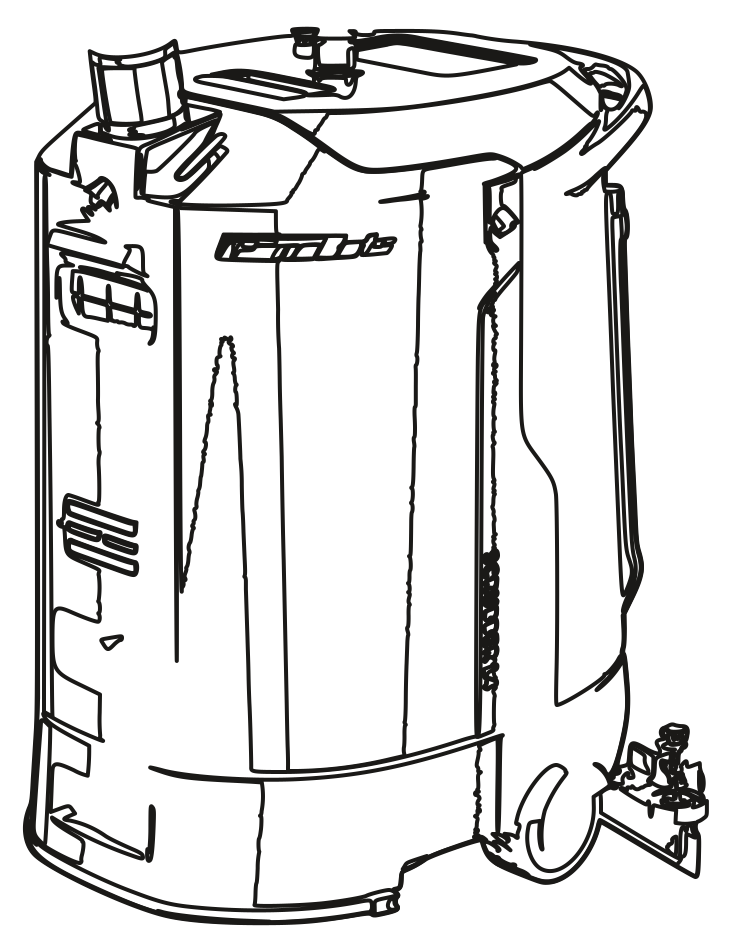
The mechanism is what makes it a new product line rather than another scrubber. According to Gausium's own technical blog, a roller at the front „focuses purely on sweeping, feeding dust, dirt and debris into a built-in debris tray", and a separate disc-brush deck „follows behind on the same pass". The order matters more than the combination: „sweeping happens first — debris carried into the tray before any water touches the floor. Only then does the dedicated disc deck behind apply water and scrub." Anyone who has run a scrubber over an unswept floor knows why. Dry debris plus water is sludge, sludge clogs the squeegee, and the machine then spreads what it was supposed to pick up. Mira is built so that situation cannot arise.

In the portfolio the Mira sits in the middle. Below it is the compact 4-in-1 Gausium Phantas, a distinctly smaller machine at 330 mm scrubbing width and 10 kg cleaning pressure, officially rated at a practical 350–700 m²/h. Above it is the Marvel, the same sweep-and-scrub concept scaled up: 1,108 × 699 × 1,168 mm, 220 kg, 600 mm scrubbing width, 80 and 70 litre tanks, 120 Ah, 850 mm minimum pass width. Marvel sweeps with dual front side brushes rather than a roller, which Gausium describes as the better solution for large debris; Mira's roller is aimed at the fine-dust profile of supermarkets and retail. Gausium's recommended cleaning area for the Mira is 800–2,000 m² per site.

02

The verified figures — and what the theoretical throughput actually is

Start with what is solid, because the official base is unusually consistent: the specification page and both brochures agree line by line. The Mira measures 680 × 550 × 900 mm at a net weight of 130 kg. Working widths are 400 mm scrubbing, 750 mm sweeping and 620 mm dust mopping. Maximum cleaning pressure is 25 kg across two disc brushes. Tanks hold 22 litres fresh and 20 litres waste water. The battery is lithium iron phosphate with 60 Ah, giving maximum runtimes of 4 hours scrubbing, 8 hours sweeping and 10 hours dust mopping. Minimum pass width is 660 mm, minimum U-turn width 950 mm, gradeability 6°, top speed 1.4 m/s. Approved floor types per the official product page: natural stone, artificial marble and granite, ceramic tiles, PVC vinyl and epoxy.

Now the theoretical throughput, because it is the number every dealer will lead with. Gausium states a maximum of 2,016 m²/h scrubbing, 3,780 m²/h sweeping and 3,124 m²/h dust mopping. Do the arithmetic: 0.4 m working width × 1.4 m/s × 3,600 seconds = 2,016 m²/h. 0.75 m × 1.4 m/s × 3,600 = 3,780 m²/h. And 0.62 m × 1.4 m/s × 3,600 = 3,124.8, published as 3,124. Every one of these figures is working width multiplied by top speed — a machine driving flat out in a straight line forever, with no turns, no overlap, no obstacle stops, no refills. That is not a criticism of Gausium; the same arithmetic produces the theoretical figures across this entire class, and the brochure footnote says so plainly: the specifications derive from Gausium lab test results and actual performance may vary in specific applications. It is simply a reason to plan with the recommended 800–2,000 m² per site rather than the m²/h headline.

The tank sets the real limit before the battery does. Four hours of scrubbing at the theoretical rate would be roughly 8,000 m², but 22 litres of fresh water will not last that long on any real floor — you will refill mid-run or you will need the workstation. Gausium publishes no coverage-per-tank figure for the Mira, and neither do we: any such number would be invented. Ask for it in writing with the water flow rate it assumes.

And here is what is not published at all. There is no noise figure for the Mira anywhere in the official material — not on the specification page, not in the English brochure, not in the German one. That single gap decides more than it looks: without a measured dB(A) value we would not put this machine into a hotel corridor at night, and neither should you. One German dealer advertises „Leise Reinigung im laufenden Betrieb" without attaching a number to it, which is not something you can put in a tender document. Also missing: suction power in pascal, charging time, battery voltage or kWh, IP rating, and the volume of the debris tray. There is also no published CE or conformity documentation for the Mira anywhere we could find — request the declaration of conformity before any deployment in Germany. Finally, one open conflict worth knowing about: two European dealers offer a docking workstation for the Mira under two different names, one calling it „Workstation Mira" and the other the „CS-04" dock, while Gausium's own workstation page lists only WS-01, WS-02 and WS-03 for the Scrubber 50, Scrubber 75 and Phantas — no Mira model at all. Which unit exists, and what plumbing and footprint it needs, is a question for the vendor.

03

Measured against the machines we do operate

The head-to-head is with the CenoBots L3, and it is closer than either manufacturer would like. Both machines scrub 400 mm wide with a dual disc brush, both top out at 1.4 m/s, and both therefore land on exactly the same theoretical 2,016 m²/h. Where they differ: the Mira presses harder (25 kg against the L3's 18 kg) and adds a sweeping stage the L3 does not have. The L3 carries more water (25 and 25 litres against 22 and 20), charges in 1.5–2 hours, navigates with a 96-beam 3D LiDAR and analyses the floor with a 100-TOPS Nvidia chip for automatic carpet detection, and its docking station refills, doses detergent and drains automatically, fed by the 60-litre WT3 mobile water tank. It also has something no datasheet shows: our own service history behind it. This is not a gap the Mira fills, it is a line-up decision.

The gap it does fill is the two-pass workflow. Today, a site with dry debris and wet soiling needs two machines from us: the Pudu MT1 sweeps it dry at up to 1,800 m²/h over 700 mm into a 35-litre hopper — a purely dry machine, no water anywhere in the process — and an L3 or L4 scrubs afterwards. The Mira collapses that into one pass, and that is genuinely the reason it is worth watching. The honest limit sits in the same sentence: Gausium does not publish the volume of the Mira's debris tray, and a tray sized for a 130 kg combination machine is not going to be a 35-litre hopper. On floors with real debris volume, emptying frequency is the question to ask, and the sweeper class it competes with in that mode is covered in our comparison of sweeping robots.

Two more reference points. The CenoBots L4 runs up to 1,944 m²/h over 450 mm with a 38-litre fresh water tank and 4.5 hours of runtime; its waste tank is given as 32 litres by the official EU datasheet and as 36 litres by three distributors, so we leave that number open. The „75 % water savings" that circulates with this machine has no manufacturer source — CenoBots' current official pages carry no percentage at all, only the qualitative Smart Flow. Where the Mira wins on the added sweeping stage, the L4 wins on refill intervals, which on sites without a nearby water connection decides the day. And the Pudu CC1 is the step down: 700–1,000 m²/h, 500 mm, 15 and 15 litre tanks, a published maximum suction of 17,000 Pa and an operating noise below 70 dB(A). That last figure is the one that matters here, because the CC1 has it and the Mira does not.

One word on the narrow-aisle claim, because it gets overstated. The Mira's 660 mm minimum pass width is genuinely remarkable for a 130 kg machine carrying both a sweeping roller and a scrubbing deck — for our L4 we state 80 cm passages, so the Mira is the narrower machine. But it is not the narrowest figure in its own manufacturer's catalogue: the much smaller Phantas passes 650 mm officially. Read 660 mm as „narrow for this capability class", not as „narrowest". If you are still working out which category of machine your building needs at all, start with our guide to scrubber robots.

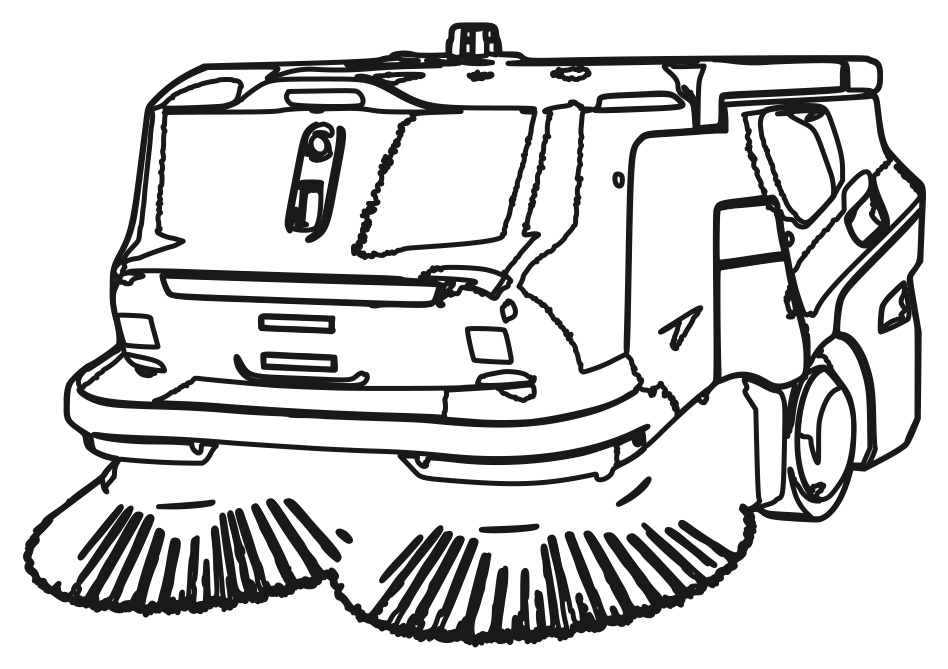
L3
L4
MT1
L3scrubber, 400 mmL4scrubber, water-savingMT1dry sweeper
Pictograms: vectorized 1:1 from our product reference photos — not illustrative icons.
04

Cloud, sensors and the questions to settle before a German procurement

What is officially documented is short and clear. The German brochure lists „Müheloser Fernbetrieb" as a key feature and describes high-precision 3D-LiDAR-based mapping, navigation and setup, supporting full remote operation and fleet management. So there is a cloud, and operating data goes into it. The Drop & Go deployment is described on the official product page as needing „no professional mapping, no complex configuration, and no technical expertise", with the robot adapting to layout changes in real time and no manual remapping. Treat that last part as a manufacturer capability claim rather than an operational fact until someone has run one in your building — every autonomous machine we operate needed setup work its brochure did not mention.

The sensor question is the one to press on, because the sources diverge. Gausium's official Mira material names only the 3D-LiDAR-based navigation. A German dealer lists something considerably larger for the same machine: „3D-LiDAR, Laser, 2D-LiDAR, 3D-Tiefenkamera, RGB-Kamera, Kollisionssensor, Anti-Drop-Sensor". Whether an RGB camera is on board is not a technical footnote. It decides whether you need a data protection impact assessment, whether your works council has to be involved, and whether the machine can go into patient or customer areas at all. Get the sensor list for the exact build you are being offered in writing, and if there is a camera, get its data handling in the same document. We work through what to ask, and in what order, in our note on data protection with cleaning robots.

On where the data goes, the public record is thinner than a German buyer needs. Gausium's privacy policy states that collected personal information „will be stored on Amazon Cloud servers in your country or region" and that „you can choose the cloud server area where your personal information will be stored based on your location"; it also contains a clause on transmitting domestically collected personal information to overseas institutions. It names no concrete EU location and does not mention the GDPR. Separately, Gausium's CTO Dr. Baoxing Qin stated in February 2026 that the company „is fully GDPR-compliant, collecting training data exclusively from the China market, validating models there, and then deploying validated software upgrades to overseas fleets without collecting any customer data from international markets". That is a statement, not a contract — and the distinction is the whole point. It also does not stand unopposed. The Clingendael Institute, the Netherlands Institute of International Relations, reported that data from Gausium robots is stored in Singapore and questioned whether it enjoys GDPR protection there. Manufacturer and think tank contradict each other, no public document resolves it, and we are not going to resolve it for you: this is something that has to be settled contractually before deployment, and for public-sector buyers it is a knock-out until it is.

Add the structural facts. Gausium lists exactly one European office, in Zaltbommel in the Netherlands, alongside Shanghai and Hong Kong; there is no German subsidiary. German sales run through independent dealers, which means your service level, spare-parts lead time and escalation path come from the dealer contract, not from the manufacturer. Our position on all of this is not that a Chinese manufacturer is a problem — it is that the burden of proof is documentary, for every vendor equally. Before deployment we would want in hand: the declaration of conformity for the delivered build, a data processing agreement under Art. 28 GDPR, the named storage region for operational and map data, the sub-processor list, the handling and retention of any camera imagery, and a written service and spare-parts commitment with response times. For public-sector tenders, hospitals and works-council-sensitive sites, those are knock-out criteria, not paperwork.

05

Who should shortlist it — and what to verify in the demo

Shortlist the Mira if your site has both problems at once: dry debris and wet soiling on the same hard floor, in the 800–2,000 m² bracket Gausium recommends, with aisles too narrow for a full-size scrubber. Gausium's own brochure names the target sectors as retail and supermarkets, production sites, warehousing and logistics, airports and metro stations, hospitals and shopping centres. In our reading, the honest sweet spot is supermarkets and specialist retail — shelf aisles, crumbs and packaging debris in front of the checkouts, wet soiling at the entrance, and a single machine covering both after closing. Warehousing and light production work for the same reason, provided the debris volume stays within a tray you have measured.

Do not shortlist it if you need documented figures the manufacturer does not publish. No noise value means no night work near sleeping guests and no dB(A) line in a tender document; no suction figure means the same for any specification requiring one. Sites well above 2,000 m² belong to the Marvel or a full-size scrubber rather than the Mira. Pure dry sweeping over large open floors stays sweeper territory, where a 35-litre hopper beats an unpublished tray. And in public-sector procurement, hold off until the conformity and data protection documents are actually in hand. If you are earlier in the process and not yet sure which category fits, our guide to choosing the right cleaning robot sorts the categories before you sort the brands.

In the demo, test what the datasheet cannot settle. Bring a sound level meter and take the dB(A) reading yourself at the actual operating point, in scrubbing mode, because that figure does not exist otherwise. Have the debris tray emptied in front of you and note how full it was after a realistic run — that tells you the emptying interval nobody has published. Run the machine down your narrowest real aisle, not the average one, and let it do a U-turn at the end where the 950 mm figure has to hold. Look at the floor behind it: in combined mode you should see a crisply swept path with a thin drying film, and in sweep-only mode no wet trace at all. Ask what it does with a piece of debris too large for the roller. Test the Drop & Go claim by having it deployed on a floor it has never seen, and time it. Get the sensor list, the conformity declaration and the data processing agreement before the pilot, not after. If you want that same list worked through with us in the room, that is exactly what our demos are for.

06

Frequent questions

It sweeps and scrubs in a single pass. A roller brush at the front picks up dust, dirt and loose debris into a built-in tray, and a rear disc-brush deck follows immediately behind with water — so debris is collected before any water touches the floor. The machine also has a dust-mopping mode and a sweep-only mode, in which it stays completely dry. Gausium gives the recommended cleaning area as 800 to 2,000 square metres per site.

Gausium states theoretical maxima of 2,016 square metres per hour scrubbing, 3,780 sweeping and 3,124 dust mopping. These are geometric figures: each one is the working width multiplied by the top speed of 1.4 metres per second, so they assume the machine drives flat out in a straight line with no turns, no overlap and no refills. The brochure notes that specifications derive from Gausium lab test results and actual performance may vary. Plan with the recommended 800 to 2,000 square metres per site instead.

Nobody publishes that. There is no decibel figure for the Mira on Gausium's specification page, in the English brochure or in the German one, and we found none in dealer material either — one German dealer advertises quiet cleaning during ongoing operations without attaching a number. A scrubber with vacuum water recovery is not silent, so until someone measures it we would not schedule this machine near sleeping guests. Bring a sound level meter to the demo and take the reading yourself in scrubbing mode.

On scrubbing they are astonishingly close: both work 400 millimetres wide with a dual disc brush, both reach 1.4 metres per second, both are therefore rated at the same theoretical 2,016 square metres per hour. The Mira presses harder at 25 kilograms against 18 and adds a sweeping stage. The L3 carries more water at 25 and 25 litres against 22 and 20, charges in one and a half to two hours, and adds 96-beam 3D LiDAR navigation with a 100-TOPS Nvidia chip for automatic carpet detection. To be clear about the perspective: the L3 figures come from a machine we run ourselves, the Mira figures from its documentation.

Gausium described the Mira in April 2026 as commercially available following its introduction at CMS Berlin in September 2025, and full German-language material exists, including an official German brochure. Sales run through independent dealers: Gausium lists exactly one European office, in Zaltbommel in the Netherlands, and has no German subsidiary. That makes your service level, spare-parts lead time and escalation path a matter of the dealer contract. Ask for delivery times, service response times and the declaration of conformity in writing.

See it instead of reading?

We show you the machines in 30 minutes at your site — free and non-binding.

Request a demo
CenoBots L3View machine →CenoBots L4View machine →Pudu MT1View machine →