Knowledge

Comparison · · 8 min read

Compact Scrubber Robots: CC1, L3 or L4?

Below roughly 3,000 square metres the choice does not get smaller, it gets harder. Our own fleet holds three machines that are all plausible in that band: the Pudu CC1, the CenoBots L3 and the CenoBots L4. Dealer pages usually settle the question with area performance — which happens to be the least comparable number these three publish. The honest answer depends on three properties of your building: how narrow the tightest point is, whether there is a water connection nearby, and whether cleaning has to reach the wall. A fourth question follows if carpet is involved. This comparison rests on manufacturer documentation — manuals, datasheets, official product pages — which we checked figure by figure. We publish no field measurements of our own for these three machines, and where sources contradict each other, the contradiction stays in the text.

Key takeaways

  • All three are compact machines, but only two fit through 70 cm: CC1 and L3. The L4 needs 810 mm of passable width.
  • The advertised area rates are not comparable. CenoBots calculates working width × top speed × 3,600 and labels the result "theoretical"; Pudu states a band of 700–1,000 m²/h for the CC1.
  • Only the CC1 has official dry modes — sweeping and carpet vacuuming. Switching modes means changing components by hand, not pressing a button.
  • Neither manufacturer publishes how much area one tank filling covers. For daily operation, the docking station decides, not the tank size.

CC1 vs. CC1 Pro — verified data

Pudu CC1CenoBots L3CenoBots L4
Size & access
Dimensions (L × W × H)629 × 552 × 695 mm765 × 572 × 1,000 mm820 × 615 × 1,075 mm
Weight75 kg127 kg150 kg
Min. passable width700 mm700 mm810 mm
Cleaning mechanics
Cleaning width500 mm (incl. side brush)400 mm450 mm
Brush contact pressurenot published18 kg20 kg
Manufacturer area rate700–1,000 m²/hup to 2,016 m²/h (theoretical)up to 1,944 m²/h (theoretical)
Water & power
Fresh water tank15 l25 l38 l
Waste water tank15 l25 l32 l*
Runtime5 h scrubbing · up to 9 h silent moppingup to 4 h4.5 h (spot cleaning)
Charging time< 3 h1.5–2 h2.7 h

All values from manufacturer documentation, as of August 2026. *The current official pages state no waste water capacity for the L4; the 32 l come from the 2024 EU datasheet, while three distributors state 36 l. The L3 length is given as 765 mm by the product page and brochure, as 763 mm by the 2026 full-line catalogue. For the L4, the EU datasheet states 800 mm passable width, the current product page 810 mm. The L3 brochure attributes the 4-hour runtime to ECO mode; the only official L4 runtime figure applies to spot cleaning.

01

Below 3,000 m², the brand is not what decides

Three machines in our fleet cover the compact and mid-size band, and they are genuinely different animals. The CC1 is a four-in-one device that can also clean dry. The L3 is the narrow specialist with the highest published AI compute figure. The L4 is the largest of the three and the only one with a defined edge-cleaning distance. What follows compares them on manufacturer documentation only: Pudu's operation guide and official product page, CenoBots' official product pages, the 2026 full-line catalogue, the workstation flyer and the EU datasheet. We are not adding field data — the one machine in our portfolio for which we publish owner-measured numbers is the Nexaro, and it is a vacuum, not a scrubber.

The number everyone compares first is the one that survives scrutiny worst. For both CenoBots machines the advertised area rate is pure arithmetic: working width × top speed × 3,600. 0.40 m × 1.4 m/s gives the L3 its 2,016 m²/h, 0.45 m × 1.2 m/s gives the L4 its 1,944 m²/h. The manufacturer says so openly — its own datasheets label the row "Max. Theoretical Productivity". That also exposes how little the figure carries: the narrower machine ranks above the wider one purely because it is allowed to drive faster. No turning, no overlap, no refill stops and no obstacles are included. Pudu's 700–1,000 m²/h for the CC1 is a band rather than a ceiling, which means the two figures cannot be lined up against each other at all.

What does decide is measurable in your building within an hour: the narrowest point on the route, the distance to a water connection, whether skirting boards and shelf plinths have to be clean, and how much of the floor is not hard flooring. Whether a scrubber is the right class in the first place is the subject of our scrubber-dryer guide; if you are earlier than that and still weighing wet against dry against vacuuming, start with which cleaning robot fits which operation.

02

The three machines in profile

The CC1 is the smallest and lightest of the three: 75 kg, 629 × 552 × 695 mm, a 500 mm cleaning width including the side brush, 15 litres each of fresh and waste water, and an official 700–1,000 m²/h. Its manual states a minimum path clearance of 70 cm and a cruise speed of 0.2 to 1.2 m/s; the official product page adds operating noise below 70 dB(A) and a maximum suction of 17,000 Pa. Runtimes are listed per mode — 5 hours scrubbing, 5 hours sweeping plus vacuuming plus mopping, 4 hours carpet vacuuming, 9 hours silent mopping — with a footnote declaring all of them lab measurements at the lowest gear setting, from 100 % down to 10 % battery. The four-in-one claim is real: alongside wet scrubbing, the manual documents a dry sweeping mode with three methods. Automatic charging and automatic water refilling and draining are listed as supported "in conjunction with the docking station", which the same table lists as an optional function.

The L3 is the computing-heavy one and, together with the CC1, the narrowest: 127 kg, 765 × 572 × 1,000 mm, 400 mm scrubbing width with dual disc brushes at 18 kg contact pressure, 25 litres per tank, 1.4 m/s, a minimum passable width of 700 mm and an Nvidia chip rated at 100 TOPS. Charging takes 1.5 to 2 hours, runtime is stated as up to 4 hours — the brochure attributes that figure to ECO mode. On the LiDAR, CenoBots' own documents disagree: the official product page and the L3 brochure state a 96-beam 3D LiDAR, the 2026 full-line catalogue states 128 beams, in both its technical data and its feature text. Most plausibly that is a model-year change, and it is worth asking per delivery which unit is fitted. The catalogue lists the sensor suite as LiDAR, depth camera and bumper sensor, and describes carpets and cables as ground-level hazards the robot detects and avoids — not as surfaces it cleans.

The L4 is the largest of the three at 150 kg and 820 × 615 × 1,075 mm, with a 450 mm cleaning width, 20 kg brush pressure and a 38-litre solution tank. It needs 810 mm to pass and 1,100 mm to turn on the spot. Its actual official differentiator is neither computing power nor throughput but edge cleaning: CenoBots states less than 3 cm from wall surfaces and titles the product page accordingly (the older EU datasheet still says less than 5 cm). The 2024 EU datasheet remains the only official source for several operating figures — 1.2 m/s, 2.7 hours charging, 4.5 hours runtime in spot cleaning, 65 dB sound pressure — because the current pages simply do not state them. Two further documentation notes: the current official pages rate the AI chip at 32 TOPS where the 2024 datasheet still printed 100, and the official water feature is called Smart Flow, meaning solution flow adapts to cleaning speed. A squeegee change is specified at 30 seconds.

Three of these machines are no longer the whole compact conversation, because the ladder around them has grown. The ET1 now sits below the CC1 at an official 300–720 m²/h with a 50 cm minimum passage width, the CC1 Pro is the AI variant of the CC1 rather than a faster machine, the BG1 sits far above this class at 2,000 m²/h in covered cleaning mode, and the CR700 enters it from the other side at 700 mm working width. All four are available through us; the ET1, the BG1 and the CR700 are newly onboarded, so their assessments are documentation-based and live in their own articles rather than in the three profiles here.

CC1
L3
L4
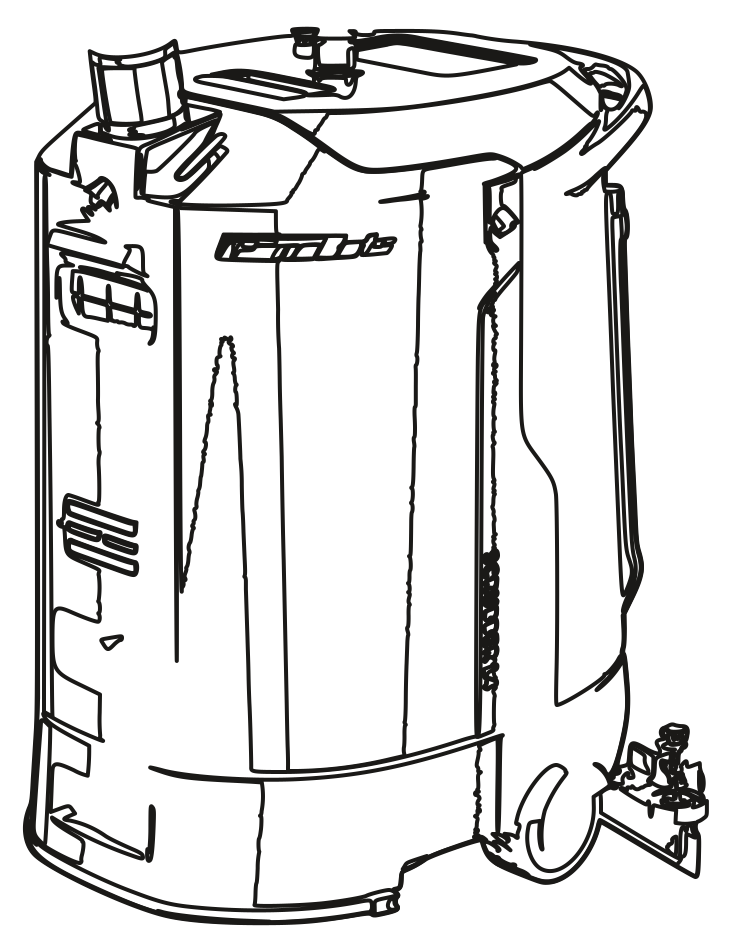
CC14-in-1 modesL3700 mm passageL4edge cleaning
Pictograms: vectorized 1:1 from our product reference photos — not illustrative icons.
03

The honest fine print

The most useful number for planning daily operation does not exist. Neither Pudu nor CenoBots publishes how many square metres one tank filling covers — not in the manual, not on the product pages, not in the brochures or the catalogue. The tank sizes rank the three machines cleanly at 15, 25 and 38 litres, but they do not tell you how often somebody has to walk over with a hose. Figures circulating online for coverage per fill are back-calculations, so we state none, and we would treat any dealer who quotes one as a dealer worth asking for the source.

The runtime figures need their qualifiers to stay honest. The CC1 has no single maximum — it has four, one per mode, all measured in the lab at the lowest gear setting. The L3's 4 hours are attributed to ECO mode in the brochure. The L4 is the awkward case: its only official runtime figure, 4.5 hours, is explicitly tied to spot cleaning in the EU datasheet, and no runtime for continuous full scrubbing is published anywhere. The same document is the sole official source for its 32-litre waste water tank, while three distributors state 36 litres and the current official pages state nothing at all. We name both values rather than picking the convenient one.

On noise the picture is uneven, and we publish only what a manufacturer publishes. The CC1 carries an official below 70 dB(A). For the L4, the EU datasheet gives 65 dB sound pressure. For the L3, the catalogue prints "≥ 64 dB(A)", which as a minimum value is plainly a misprint, and the Czech distributor states 66 dB — so we publish no noise figure for that machine until it is settled. One more claim deserves flagging because it circulates widely: the "75 % water savings" often attached to the L4 has no manufacturer source. CenoBots' current official pages carry no percentage at all; what they document is Smart Flow, and that is a mechanism, not a measured saving.

04

Four questions decide it

First: how narrow is the tightest point? The CC1 needs 70 cm of path clearance per its manual, the L3 a minimum passable width of 700 mm, the L4 810 mm per its current product page — 800 mm per the older EU datasheet. Pudu and CenoBots label the value differently, but functionally it answers the same question: the narrowest gap the machine still gets through. This is not a comfort figure, it is an exclusion criterion. A shelving aisle at 85 cm, a fire door at 80 cm, a pallet standing half in the way — a machine that does not fit has an area rate of zero, whatever the datasheet says. Measure the tightest points before you measure the total area.

Second: where is the water? Without a station, somebody fills and empties by hand, and in daily operation that is exactly the recurring manual work the machine was supposed to remove. The CC1's manual lists automatic charging plus automatic water refilling and draining as supported in conjunction with the docking station, itself listed as optional equipment. For the L3, CenoBots offers the WS3 workstation, which handles charging, fresh water, drainage and detergent, and additionally the WT3 mobile water tank with 60 litres of fresh and 50 litres of waste water — explicitly built for sites without a plumbing connection. The L4 has a four-in-one workstation covering the same four functions. Which of those a site actually needs depends on the distance to the nearest drain, and keeping that work off your staff is what our full-service model is for.

Third: does cleaning have to reach the wall? This is the L4's question, and it is the reason to accept its 810 mm. CenoBots states edge cleaning at less than 3 cm from wall surfaces, and the official product page is titled around exactly that capability. For the L3 no official edge figure exists — only a distributor states less than 5 cm. Pudu prints a footnote reading "< 2 cm edge to edge" on the CC1 product page without defining what is being measured, so we do not treat it as a comparable edge-cleaning specification. If skirting boards, shelf plinths and column bases are the places your team currently finishes by hand, that is a real and documented argument for the L4.

Fourth: what are the floors, and how much of them is not hard flooring? Pudu's manual gives the CC1 an application scope of terrazzo, marble, floor tiles, epoxy resin, sandstone, artificial stone and low-pile carpet — parquet and laminate do not appear on that list, and no scrubber wet-cleans carpet in any case. Carpet on the CC1 is vacuumed dry in a dedicated mode, and the honest detail is in the manual: for that mode the side brush is removed, the sweeping brush installed and the carpet vacuum unit fitted, which the manual explicitly marks as an optional part. Switching between wet and dry is a hardware change a person performs, not a setting. The two CenoBots machines are wet-only: the L3 treats carpet as a hazard to avoid, and CenoBots publishes no dry function for the L4 at all, so coarse debris has to be swept before the wet pass. If the CC1 is where this leads you, the next question is which version — our comparison of CC1 and CC1 Pro settles that one.

05

Which machine for which venue

Supermarkets and retail are the classic case, and CenoBots lists retail officially as a target segment for both machines. Here the split follows the layout: the L4 plays its edge cleaning along shelf plinths and skirting boards — exactly the strip that otherwise gets finished by hand — provided the aisles give it 810 mm. Where they do not, or where back rooms and cold-store corridors sit behind narrow doors, the CC1 and the L3 get through at 70 cm while the L4 does not.

In hotels the area per zone decides, not the total. Lobby, corridors and conference rooms are separate, often small units with doors between them, and CenoBots lists hotels as an official segment for the L3, whose 2026 catalogue names retail, office buildings, hotels, schools and hospitals. For the L4 we found no published segment list at all. The CC1 fits that structure particularly well at 70 cm passable width and with a published noise value of below 70 dB(A), which matters when cleaning happens while guests are in the building. What no machine in this class changes: the floor stays damp for a while after the pass, so occupied-venue operation means signage, not just scheduling.

Schools are an official segment for the L3, named directly in its catalogue; for the L4, as with hotels, CenoBots publishes no segment list. Their pattern suits autonomous scrubbing: hard floors, long corridors, planable windows outside teaching hours, and heavy entrance soiling in winter. The size question resolves itself from the corridors and doorways, which is why the passable-width check comes first here too.

Gyms are the case where we have to be explicit: no manufacturer in this comparison lists fitness studios as an official application scenario, so what follows is our own operational reasoning rather than a manufacturer claim. Studio floors are typically mixed — hard flooring in circulation areas, rubber under the free-weight zone, carpet islands in some layouts — and mixed floors are precisely where the CC1's dry modes have an argument the two wet-only machines do not. Whichever machine, the wet pass belongs in a closed window before the first members arrive, because the drying film is a slip hazard until it is visibly gone. Which is really a measuring job in your building: tightest point, area, night window, water connection — four numbers that a demo on site produces in an afternoon.

06

Frequent questions

The Pudu CC1 and the CenoBots L3. Pudu states a minimum path clearance of 70 cm for the CC1 in its manual, CenoBots a minimum passable width of 700 mm for the L3. The L4 needs 810 mm according to its current official product page, and 800 mm according to the older EU datasheet — so at exactly 80 cm it is out or borderline, depending on which document you go by. Measure the narrowest point on the intended route first; a machine that does not fit through cleans nothing at all.

Neither Pudu nor CenoBots publishes that figure for these machines — not in the manuals, not on the product pages, not in the brochures. The tank sizes rank them clearly: 15 litres each of fresh and waste water on the CC1, 25 litres on the L3, 38 litres of fresh water on the L4. Coverage-per-fill numbers circulating online are back-calculations without a source. In daily operation the more useful question is whether a docking station changes the water automatically, because that is what removes the manual refilling.

No scrubber wet-cleans carpet. The CC1 vacuums low-pile carpet dry in a dedicated mode, which per Pudu's manual requires removing the side brush, installing the sweeping brush and fitting the carpet vacuum unit — a part the manual marks as optional. The L3 treats carpets and cables as ground-level hazards it detects and avoids, and CenoBots publishes no dry function for the L4 at all, so coarse debris has to be swept before the wet pass there. If a large share of your floor is carpet, the class you need is a vacuum robot, not a scrubber.

Not in any way you would notice on site. Both figures are arithmetic: working width times top speed times 3,600. The L3 gets 2,016 m²/h from 400 mm at 1.4 m/s, the L4 gets 1,944 m²/h from 450 mm at 1.2 m/s, and CenoBots labels both as maximum theoretical productivity. The narrower machine ranks higher purely because it may drive faster. Turning, overlap, refill stops and obstacles are not included in either number, and Pudu's 700–1,000 m²/h band for the CC1 is not measured the same way at all.

There is no manufacturer source for that number. CenoBots' current official pages state no water-savings percentage for the L4 anywhere; the figure comes from EU importer marketing material dating from 2024 and appears in no datasheet. What the manufacturer does document is a feature called Smart Flow, where solution flow adapts to cleaning speed. That is a plausible mechanism for using less water, but it is not a measured saving, and we do not present it as one.

See it instead of reading?

We show you the machines in 30 minutes at your site — free and non-binding.

Request a demo
Pudu CC1View machine →CenoBots L3View machine →CenoBots L4View machine →