
Knowledge

Machine profile · · 9 min read

Pudu BG1 and BG1 Pro: What the Large Scrubber Robot Really Does

The Pudu BG1 is the machine that pushes Pudu out of the compact class and into large-format floor cleaning: a 344-kilogram robot that sweeps dry and scrubs wet in a single pass. One thing up front, because everything below rests on it: the BG1 is available through our programme and newly onboarded there. What follows is a documentation-based assessment — every figure taken from the official Pudu specification tables for both variants and the launch press release, read by an operator who runs scrubber robots one and two classes below it every day. What that gives you is the part manufacturer and dealer pages leave out: which number is a planning figure and which is a mode, what separates BG1 from BG1 Pro in the official tables, and the list of values Pudu simply does not publish.

Key takeaways

  • The BG1 is available through us and newly onboarded — this assessment comes from Pudu’s official English and German spec tables and the launch press release of 25 March 2026.
  • Sweeping and scrubbing in one pass: a front dry-sweep module with a 5 L debris bin, a rear scrub module with squeegee, 550 mm working width (708 mm with side brushes), 75 L fresh and 60 L waste water, up to 7.5 h runtime, approx. 344 kg.
  • Plan with 2,000 m²/h. The 6,000 m²/h that distributor pages headline is Pudu’s spot-cleaning mode, not full-coverage performance.
  • BG1 and BG1 Pro differ in exactly two published specs: 3D LiDAR instead of LiDAR, and 1.2 instead of 1.0 m/s. Noise, suction, gradeability, CE documentation and the workstation are unpublished — ask for all of it in writing.

CC1 vs. CC1 Pro — verified data

BG1BG1 Pro
Platform — officially identical
Covered cleaning modemax. 2,000 m²/hmax. 2,000 m²/h
Spot cleaning modemax. 6,000 m²/hmax. 6,000 m²/h
Cleaning width550 mm / 708 mm with side brushes550 mm / 708 mm with side brushes
Fresh / waste water tank75 l / 60 l75 l / 60 l
Agent tanks · debris bin2 tanks, approx. 7 l total · 5 l2 tanks, approx. 7 l total · 5 l
Battery · runtime sweeping + scrubbing90 Ah (48 V platform) · max. 7.5 h90 Ah (48 V platform) · max. 7.5 h
Charging timeapprox. 3 h (AC ≥ 180 V) / 4.5 h (AC ≤ 180 V)approx. 3 h (AC ≥ 180 V) / 4.5 h (AC ≤ 180 V)
Dimensions (with squeegee)1,195 × 760 × 1,303 mm1,195 × 760 × 1,303 mm
Weightapprox. 344 kgapprox. 344 kg
Min. path clearance85 cm85 cm
Communications4G, Wi-Fi, Bluetooth; e-gate / lift optional4G, Wi-Fi, Bluetooth; e-gate / lift optional
The only official differences
NavigationLiDAR + 3D VSLAM3D LiDAR + 3D VSLAM
Cruise speed0.2–1.0 m/s0.2–1.2 m/s
Not published by Pudu
Noise in dB(A)not publishednot published
Suction in Panot publishednot published
Gradeabilitynot publishednot published
Brush pressure as a figurenot publishednot published
CE / conformity documentsnot publicly availablenot publicly available
Workstation dimensions, plumbingnot publishednot published

The Pro’s higher top speed does not change the official area figures — Pudu rates both variants at 2,000 m²/h in covered cleaning mode and 6,000 m²/h in spot cleaning mode. Dimensions without the squeegee are given as 1,120 × 660 × 1,303 mm for both. One row is not as settled as it looks: the agent tanks. The product page reads as roughly 7 litres across both tanks, while the launch press release says "dual 7L independent agent tanks", which can equally be read as 7 litres each. We have not been able to resolve which is meant — confirm it if detergent stock matters to your service interval.

01

What the BG1 series is — and why it is not simply a bigger CC1

Pudu announced the BG1 series on 25 March 2026 and calls it, in its own words, the "AI-Native Large Scrubber-Dryer Robot". The series has exactly two members, PUDU BG1 and PUDU BG1 Pro; there is no third variant. Per that March 2026 press release, the series was slated to debut globally in April at MODEX in Atlanta and Interclean Amsterdam. Worth knowing when you compare pictures: Pudu states in a footnote on its own product page that the machine shown in all website images is the BG1 Pro.

The construction is what makes this a different category rather than a bigger version of something. At the front sits a dry sweeping module that picks up dust and paper into a 5-litre debris bin; behind it a scrubbing module works wet and a squeegee recovers the dirty water. Dry and wet therefore happen in one pass, not in two runs. On top of that sits the perception layer Pudu markets as the AI-native part: the machine is stated to detect wet spills and retract the sweeping modules so it does not spread them, and to automatically boost brush pressure on stubborn stains. An extendable scrubbing brush moves out sideways to clean flush against walls and shelving. All of that is officially documented as a feature — none of it comes with a measured number, and Pudu’s framing as an industry first is a marketing claim we do not repeat as fact.

The physical class follows from the numbers: approximately 344 kg, 1,303 mm tall, 1,195 mm long with the squeegee, and a minimum path clearance of 85 cm. That is a machine for wide aisles and load-bearing floors, not for office corridors. Our compact CC1 is a 4-in-1 that switches between modes on far smaller floors; the BG1 is a large-format machine that combines two work steps. If you want the split inside the compact class instead, our comparison of CC1 and CC1 Pro covers it.

Availability in the German-speaking market is real, but staggered. The hardware has been shipping in Europe since spring 2026 — the first European deployment reported in the trade press was a Dutch cleaning provider in April 2026, a single PR-derived report we treat as unconfirmed. In Germany, distributors such as GIOBOTICS in Kiel market the BG1 with demos and a catalogue on request; in Austria, SCHMACHTL presents the BG1 Pro. In the UK, by contrast, a distributor still lists it as "Expected release: September 2026". Which means: ask what is actually deliverable, and in which variant.
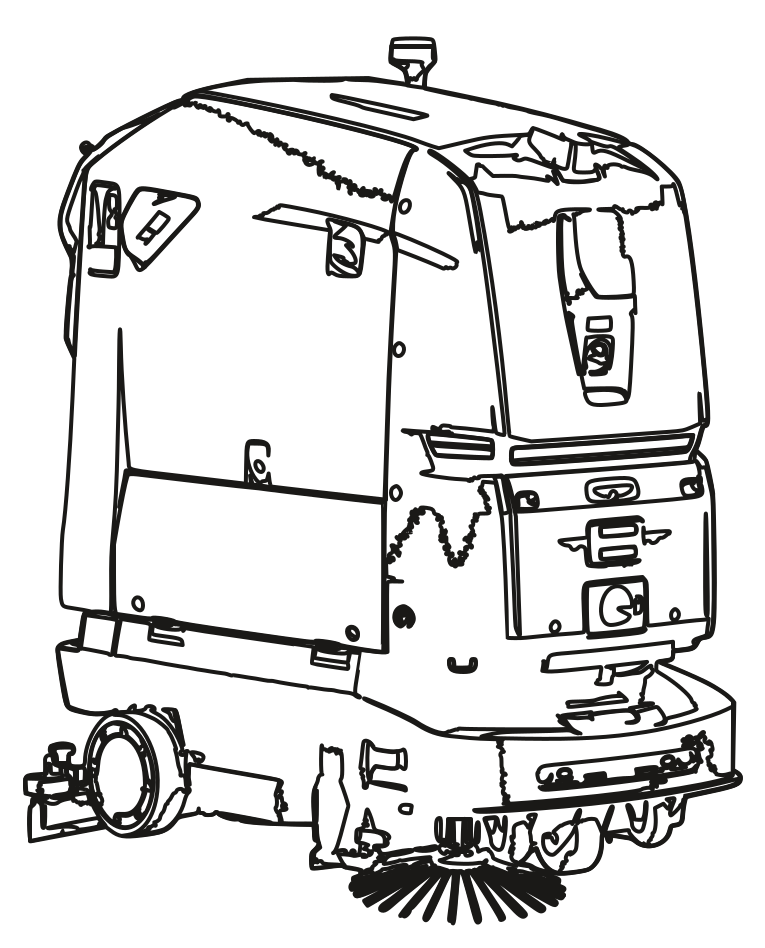
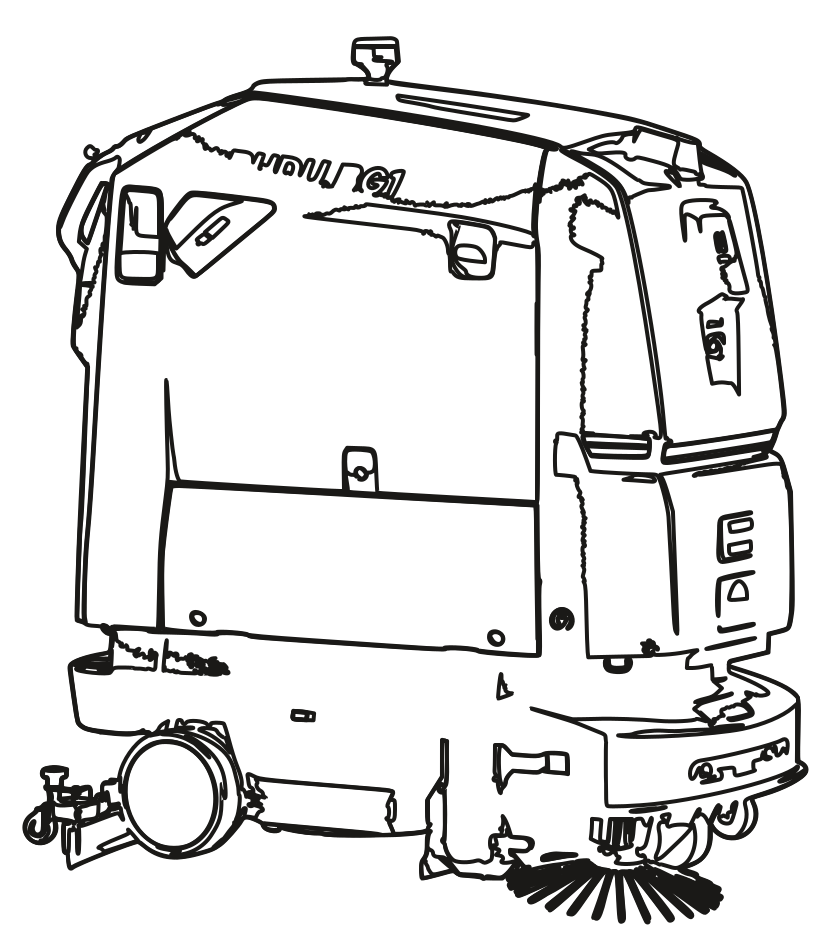
BG1
BG1 Pro
BG1BG1 Pro
Pictograms: vectorized 1:1 from our product reference material — not illustrative icons.
02

The verified key figures — and the number you must not plan with

Start with the solid part. Pudu’s official spec tables give a cleaning width of 550 mm, or 708 mm with the side brushes engaged. The tanks hold 75 litres of fresh and 60 litres of waste water, plus two separate cleaning-agent tanks and a 5-litre debris bin for the sweeping module. The battery is a 90 Ah pack on a 48 V platform, which Pudu itself translates as equivalent to 180 Ah at 24 V; runtime for combined sweeping and scrubbing is given as a maximum of 7.5 hours, charging time as roughly 3 hours above 180 V mains and roughly 4.5 hours below it. Dimensions are 1,195 × 760 × 1,303 mm with the squeegee and 1,120 × 660 × 1,303 mm without, weight approximately 344 kg, minimum path clearance 85 cm. The English and German official pages carry identical numbers, which is not something we can say about every manufacturer.

Now the number that gets abused. Pudu states two separate area figures: a maximum of 2,000 m²/h in covered cleaning mode and a maximum of 6,000 m²/h in spot cleaning mode. Covered cleaning means the machine works the whole surface; spot cleaning means it drives to detected soiling and cleans there. Only the first is a planning figure. German distributor pages nevertheless headline the machine with "Bis zu 6000 m2 pro Stunde reinigen", and jk.de does name a mode for it — the wrong one: „bis zu 6000 m²/h bei nur einem Arbeitsgang (Kehren & Schrubben)". Sweeping and scrubbing is exactly the full-coverage work the 2,000 m²/h figure applies to, which makes that headline a threefold overstatement. If you size a night shift on 6,000 m²/h, you will be short by a factor of three.

One detail worth clarifying before you sign: the agent tanks. The official specification table lists "Dual Agent Tanks, total approx. 7 L" — two tanks holding about seven litres between them. The launch press release instead speaks of "dual 7L independent agent tanks", which reads as seven litres each. Those are two different volumes, so ask which one applies to the machine in your quote. What is not in dispute is the function: the robot doses two different agents automatically and, per Pudu, adjusts the mix to the type of soiling at millilitre precision.

And one consequence the datasheet does not spell out. A machine that puts 75 litres of clean water down has to take roughly the same volume back up: 60 litres of waste water per fill has to be disposed of somewhere. Without the optional workstation, that is manual work — filling, draining, emptying the debris bin, swapping the snap-on consumables, which Pudu says takes under a minute per part. Plan the water logistics before the robot, not after it.

03

BG1 or BG1 Pro: exactly two documented differences

Pudu publishes two complete spec tables, one per variant, and they diverge in precisely two rows. Navigation: the BG1 uses LiDAR plus 3D VSLAM fusion positioning, the BG1 Pro uses 3D LiDAR plus 3D VSLAM. Cruise speed: 0.2–1.0 m/s on the BG1, 0.2–1.2 m/s on the Pro, so 20 percent more top speed. Everything else — area figures, cleaning widths, all four tank volumes, battery, runtime, charging times, dimensions, weight, path clearance, communications — is listed identically for both machines.

What that means commercially is narrower than most sales conversations suggest. The Pro buys better three-dimensional perception and a higher top speed, which is an argument on complex, dynamic sites with mixed traffic, changing layouts and low overhead structures. On structured, repetitive warehouse and retail floors the standard BG1 sees the same official area performance. Note in particular that the extra speed does not change the m²/h rating: Pudu rates both variants at 2,000 in covered cleaning mode. Anyone selling the Pro to you as the faster-cleaning machine is describing a spec that Pudu does not publish.

One per-variant question is genuinely open, and we will not resolve it silently. Ride-on mode — the stowable platform for manual control during mapping and long transitions — is presented in both the official feature list and the press release as a series feature, meaning both machines. At least one reseller page instead phrases it as something the BG1 Pro "also fully supports", which reads as Pro-exclusive. No source actually denies ride-on for the base BG1 — it is the wording that leaves room for doubt, not a contradiction on the record. Still: if ride-on matters to your deployment plan, get its availability confirmed in writing for the exact variant you are ordering rather than trusting either page.

04

Where it sits against the scrubber ladder we run every day

The scrubber ladder we run ourselves has three steps, and the BG1 sits above all of them. The CC1 is the compact entry: officially 700–1,000 m²/h in full-coverage cleaning, 500 mm cleaning width, 15 + 15 litre tanks, 5 hours of scrubbing runtime and up to 9 hours in silent mopping, below 70 dB(A) and a published maximum suction of 17,000 Pa. The L4 is the mid-size machine for narrow aisles: up to 1,944 m²/h at 450 mm working width, 38 litres of fresh water, up to 4.5 hours, LiDAR SLAM — its waste tank we leave unquantified, because the official EU datasheet says 32 litres and three distributors say 36. Above that sit the L3, rated at a theoretical 2,016 m²/h and available with an optional docking station, and the L50 as the industrial machine: 2,200 m²/h, a 55-litre tank system, up to 6 hours runtime, a 510 mm disc brush and a 740 mm squeegee. Where a scrubber is the right class for your floor in the first place is what our scrubber robot guide sorts out.

Compared like for like, the BG1 does not win the area contest. Its 2,000 m²/h in covered cleaning mode sits below the L50’s 2,200 and roughly level with the L3. What it brings instead is tank volume and endurance — 75 litres of fresh water and up to 7.5 hours against 55 litres and 6 hours on the L50 — and above all the integrated sweeping module. Our L-series machines scrub wet. Coarse dry debris either gets picked up beforehand by a sweeper or it ends up in the waste water tank. Reaching the BG1’s combined result with the machines we run daily means pairing a dry sweeper such as the MT1 Max at 2,200 m²/h with 35 litres of debris capacity and a scrubber such as the L50: two machines, two passes, two charging regimes.

That is the honest trade-off. One pass instead of two is a genuine operational advantage in halls where the same floor carries both dust and traffic film. The price is size and infrastructure: at approximately 344 kg the BG1 weighs roughly four and a half times the 75 kg of a CC1, it needs 85 cm of clearance everywhere it works, it stands 1,303 mm tall, and every claim about round-the-clock autonomy depends on an optional workstation for which Pudu publishes no dimensions, no plumbing requirement and no footprint. Before that comparison becomes a decision, the category question comes first — which cleaning robot fits which operation walks through it.

05

Which venues it fits — and what to settle in the demo

Pudu names its own target list: retail complexes, warehouses, industrial plants and transportation hubs, plus high-ceiling facilities and public spaces where robots work alongside people. Read against the hard numbers, that list holds up. Large-format supermarkets and DIY stores with wide main aisles, warehouses and production halls with load-bearing concrete, and airports and similar transport buildings are the environments where an 85 cm clearance requirement and a 344 kg machine are unremarkable rather than a problem. What does not fit is anything narrow, anything with a weight-limited lift, and anything where the value comes from working around furniture rather than across open floor.

The blocking question for German buyers is not performance but noise, and here we have to say plainly that no answer exists. Pudu publishes no dB value for the BG1 or the BG1 Pro, and neither does any distributor we checked. Careful with a specific trap: Pudu’s own website carries a 76 dB(A) figure in its global page data, but that value belongs to the SH1 handheld scrubber, not to this machine. Anyone quoting you 76 dB(A) for a BG1 is quoting the wrong robot. Until there is a written figure or an on-site measurement, no night-shift promise near noise-sensitive areas can be responsibly made for this machine.

So take a list into the demo. Get a dB measurement at your actual operating point, in writing. Ask for the EU declaration of conformity — no CE documentation for this series was publicly findable anywhere in our research, and in tenders that is a knock-out item, not a formality. Get the workstation specified: dimensions, footprint, water supply, drain, power, and what "24/7 standby" costs in infrastructure, because every autonomy claim rests on it. Ask for gradeability and confirm your ramps, and have the 344 kg checked against your floor loads and lift capacities. Drive the machine through your narrowest real aisle, not the average one. Ask which variant the quote covers and whether ride-on is included. And ask where 60 litres of waste water go on your site every fill.

The BG1 is available through us. Those points are not settled by any published document, and we will not pretend otherwise. What we can do is put that list to the manufacturer with you and have the same questions asked on your floor, with our own service behind them — which is what a demo appointment is for.

06

Frequent questions

Pudu states a maximum of 2,000 m²/h in covered cleaning mode and a maximum of 6,000 m²/h in spot cleaning mode, identically for the BG1 and the BG1 Pro. Only the 2,000 m²/h is a planning figure for full-coverage cleaning; the 6,000 m²/h applies to targeted cleaning of detected soiling. Distributor pages that headline 6,000 m²/h overstate full-coverage performance threefold — jk.de even attaches the figure to a named mode, „Kehren & Schrubben", which is the full-coverage work the 2,000 m²/h figure covers.

Two published specs, no more. The BG1 navigates with LiDAR plus 3D VSLAM, the Pro with 3D LiDAR plus 3D VSLAM. The BG1 runs at 0.2 to 1.0 m/s, the Pro at 0.2 to 1.2 m/s. Cleaning performance, cleaning widths, all tank volumes, battery, runtime, charging times, dimensions, weight, path clearance and communications are listed identically by Pudu for both machines. The higher top speed does not raise the official area figures.

Unknown. Pudu publishes no noise figure for either variant, and no distributor page we checked does either. Watch out for one trap: a 76 dB(A) value appears in the page data of Pudu’s own website, but it belongs to the SH1 walk-behind scrubber, not to the BG1. If noise matters to your site, require a written figure from the manufacturer or distributor, or measure at the demo before anyone promises night operation.

Only with the optional workstation. Pudu describes fully autonomous cycles of water exchange, charging and self-cleaning, and states that unattended operation is supported but requires that workstation. Pudu publishes no dimensions, no footprint and no plumbing requirements for it. Without the workstation, someone has to fill 75 litres of fresh water, drain 60 litres of waste water, empty the 5-litre debris bin and swap the snap-on consumables.

Yes, that is the point of the machine. A front sweeping module collects dry debris such as dust and paper into a 5-litre bin while a rear module scrubs wet and a squeegee recovers the dirty water, all in one pass. Pudu states that the robot detects wet spills and retracts the sweeping modules so it does not spread them. Like every scrubber-dryer it leaves a thin, quickly drying film behind; Pudu publishes no statement on residual dampness.

See it instead of reading?

We show you the machines in 30 minutes at your site — free and non-binding.

Request a demo
Pudu BG1 SeriesView machine →Pudu CC1View machine →CenoBots L4View machine →