Knowledge

Guide · · 11 min read

Robotic Sweepers Outdoors: What Is Actually Documented

"Robotic sweeper outdoors" is one of the most searched combinations in this market and one of the worst answered. The honest answer starts with a classification: the large majority of autonomous sweeping robots are indoor machines. Their manuals say so, and some forbid outdoor use in as many words. The interesting zone is the one in between — semi-outdoor areas such as parking decks, covered loading yards, courtyards, entrance zones and canopied walkways. Weather does not fall directly onto those surfaces, but it reaches them, and temperature, moisture, ramps and vehicle traffic change what a machine has to survive. For that middle zone there is documented technology. For the true outdoor world of streets and open lots there is a different class of machine entirely. This article separates the three zones and names, for each, what manufacturers actually publish. Where nothing is documented, nothing is claimed here.

Key takeaways

  • Three zones, not two: indoor halls, semi-outdoor areas (parking decks, covered yards, courtyards, entrance zones) and true outdoor surfaces. The commercially interesting one is the middle zone.
  • The Pudu MT1 Max is the machine in our fleet with a documented semi-outdoor scope: IP54, a water-drop sensor with protective avoidance, −10 to 45 °C with a temperature sensor, 5 cm speed bumps, 8° slopes. Pudu adds its own footnote: no cleaning tasks in extreme weather.
  • The base MT1 is the counter-example, and the contrast is the buying guidance: its manual permits indoor flat environments at 0–40 °C only and expressly forbids outdoor use on rough or non-hardened surfaces.
  • An IP code is not an outdoor release. Kemaro states the same IP54 for its K900 and scopes it in its own FAQ to a "wet indoor environment". What counts is the operating scope the manufacturer documents, not the number.
01

Three zones, not two

Most conversations about outdoor sweeping robots go wrong because they use a binary — inside or outside — where the market has three steps. Indoors means a tempered hall on a flat, hardened floor with defined thresholds and no precipitation: the situation every manufacturer designs for by default. Semi-outdoor means a roof but not four walls. Rain arrives sideways and on tyres, the temperature follows the outside air, ramps and speed bumps replace thresholds, vehicles share the lanes, and grit, leaves and de-icing salt get carried in. True outdoor means precipitation directly on the surface, frost, unpaved edges, public traffic and a completely different volume of debris.

The step from the first zone to the second is where machines get sorted out, and most of them fall at it. That is not a slur on the class — it is what the documents say. The Pudu MT1's user manual is the clearest example we have: "This product is a wheeled automatic cleaning robot, for use only in indoor flat environments, please do not use it outdoors on rough or non-hardened surfaces", with an operating range of 0 to 40 °C and up to 90% relative humidity. Neither the MT1 product page nor the official brochure publishes an IP rating. If you search for "sweeping robot" and land on a machine like this, you have found an excellent indoor sweeper — and the answer to a different question. Our comparison of robotic sweepers sorts the class out machine by machine, and the class overview explains which robot type belongs in which building at all.

The middle zone is the one worth talking about commercially, because it is where German properties actually have their problem surfaces: parking garages and parking decks, covered loading yards, inner courtyards, entrance and mall-front zones, canopied walkways between buildings. These areas are large, they get dirty faster than indoor floors, they are unpleasant to clean by hand, and they are hard to staff. They also demand more of a machine than a warehouse aisle does. Everything below is about what "more" means in documented terms — and how to check it before you sign. For the operational side of one of these surfaces, see our guide to parking garage cleaning.
02

What semi-outdoor demands — and what the MT1 Max documents

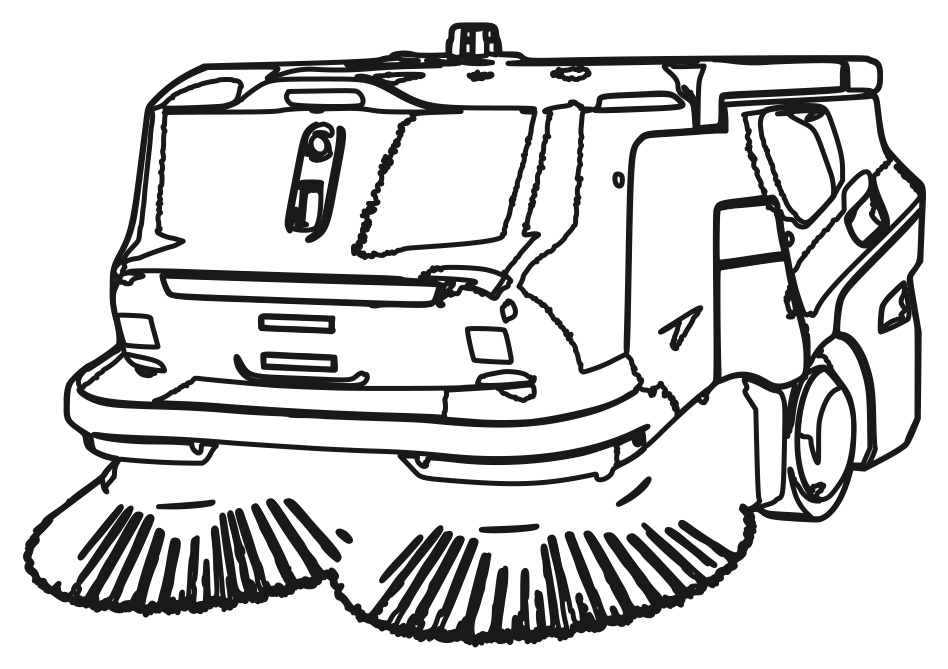
Five things change when the roof stops being a ceiling: moisture reaches the electronics, the temperature leaves the comfort band, the ground gains slopes and bumps, other road users appear, and the machine has to decide for itself what to do when it starts to rain. The MT1 Max is the machine we operate whose documentation answers all five, and it does so by design rather than by dealer interpretation: Pudu's official product name for it is "AI-Powered Outdoor & Semi-Outdoor 3D Perception Robotic Sweeper", and the product deck opens with the sentence "Building on MT1, MT1 Max is enhanced for semi-outdoor environments such as residential courtyards and for areas with high-speed dynamic obstacles like parking garages."

The hardware behind that sentence is specific. Full IP54 sealing, which Pudu itself describes as defending "against dust ingress and water spray". A water-drop sensor that "automatically detects water drops and triggers a protective avoidance mode, guiding the robot to safe zones while reducing electrical risks" — the machine does not merely tolerate the first rain, it reacts to it. An operating temperature of −10 to 45 °C, explicitly "with temperature sensor". Crossing of 5 cm speed bumps and slopes up to 8°. A 1.2-metre-high warning light plus a safety projection light with audible and visual alarms, which matters wherever cars and a robot share a lane. And an internal vibration system that keeps the filter clear during the run, because semi-open air carries more dust than a hall does. Pudu's own scenario gallery for the machine runs from parking garage, residential courtyard and campus to urban square, sidewalk, park trail, waterfront parking lot, train station square and residential parking lot. The performance figures stay where they were: max. 2,200 m²/h in cover cleaning, 7,000 m²/h in spot mode, 70 cm cleaning width, a 35 L waste container, 5–10 h run-time with standard mode stated at 8 h.

The limit is printed on the same slide as the capability, and it is the sentence that keeps this article honest. Pudu footnotes the water-drop sensor with: "Do not perform cleaning tasks in extreme weather." IP54 is protection against dust and spray, not a licence to work through a storm, and the avoidance mode exists because water on the floor is a situation to leave, not to clean. Set against the base MT1 — indoor only per its manual, 0 to 40 °C, 20 mm thresholds and 35 mm grooves, minimum 75 cm path clearance, no IP rating anywhere — the contrast is exactly the buying guidance. The MT1 is the hall machine; the Max is the machine for floors that see weather and vehicles. The full spec-by-spec split between the two is in our MT1 versus MT1 Max comparison.

MT1
MT1 Max
MT1indoor only per manualMT1 MaxIP54, semi-outdoor
Pictograms: vectorized 1:1 from our product reference photos — not illustrative icons.
03

What the rest of the market documents — and what it only implies

The assessment in this section is documentation-based, and we say so rather than implying more than the documents support. Start with the most instructive case, because it shows why an IP code settles nothing. Kemaro states in its own FAQ that "The robot is rated IP54, meaning electrical enclosure is protected from water spray from any direction" — the same code the MT1 Max carries. The very next sentences scope it: "The robot may be used in a wet indoor environment. Although it does not sweep liquids, small amounts of moisture do not affect the machine." Indoor, explicitly. The K900 Gen II factsheet does list car parks among its areas of application, alongside warehouses, bottling plants, railway stations and production areas, and it climbs ramps up to 12% — but the manufacturer's own boundary for that IP rating is a damp hall, not a weather-exposed deck. Same number, different scope.

Two more sweepers name parking garages without claiming weather resistance. The CenoBots S5 lists parking garages among its target environments and its manufacturer brochure states that it "glides through standard 32" doorways, narrow aisles, and over speed bumps", with a max. climb angle of 8°, ~2,500 m²/h, an 820 mm sweeping width and a 50 L hopper — but publishes no IP rating and no operating temperature anywhere we could find. The Adlatus SR1300 names Parkhäuser directly in the application fields of its official info document, next to industry, logistics, public facilities and shopping arcades, and it climbs ramps up to 20% (11.3°) with a 115 L hopper and class M filtration; Adlatus describes the system as developed for logistics and industrial areas, "um in großen Hallen oder Lagerräumen, Grobschmutz effizient zu beseitigen", and publishes no IP rating either. Both are honest fits for covered decks. Neither is documented for a surface that gets rained on.

The only manufacturer in this field with an explicit outdoor product line is Gausium. Its Beetle is marketed as a "Heavy-Duty Autonomous Sweeper for Indoor & Outdoor Use" at 750 mm cleaning width, 3,240 m²/h and 8° gradeability — yet its own spec page publishes neither an IP rating nor an operating temperature, which is precisely the gap you have to close before deploying anything outdoors. At Interclean Amsterdam in April 2026 Gausium announced two machines built for the gap: the Beetle 2.0 Full-Scenario Edition with an "IP54-rated protective design", an "upgraded 800 mm cleaning width" and a "WeatherSense Guard for real-time rain monitoring", and the MAX-SW with a 1,200 mm sweeping width, a stated theoretical productivity of 6,480 m²/h and "IP55-rated protection for all-weather use". Both were announcements; the release names no shipping date for either. Which leaves the rule this section is really about: a machine belongs outdoors when the manufacturer documents outdoor as its operating scope — a number in an IP row is not that document. It is also worth knowing that the machine-specific product safety standard, IEC 63327:2021, applies to automatic floor treatment machines "intended for commercial use indoors". A semi-outdoor deployment therefore sits outside what that standard was written for, which makes your own site risk assessment more important, not less. What CE marking and this standard do and do not prove is the subject of our article on safety and standards. This is not legal advice.

04

Rain, leaves and grit: what a dry sweeper handles outdoors

Start with what these machines are good at, because semi-open surfaces produce exactly that kind of dirt. Pudu's MT1 brochure describes handling "larger debris like leaves and bottles" alongside fine dust; the MT1 Max deck puts it as removing "everything from cigarette butts and paper scraps to large bottles in a single sweep" at a 70 cm width and 0 cm edge distance. The CenoBots S5 brochure names wood chips, packaging film, plastic bottles, cardboard and screws. Dry leaves, grit, cigarette ends, packaging, tyre-carried dust and the fine sand that collects on every parking deck all fall inside that profile. The practical limit is not the brush, it is the container: the MT1 and MT1 Max each hold 35 litres, and no manufacturer in this class publishes a coverage-per-container figure. After a windy autumn night a weather-adjacent deck can fill a hopper far faster than a hall does — which is an emptying-frequency question you should measure on your own surface rather than estimate.

Water is where the honest line runs. Both Pudu and Kemaro describe IP54 in their own words as protection against dust and water spray; neither describes protection against jets, standing water or immersion, and neither claims the machine may clean wet surfaces. Kemaro puts the mechanical truth plainly: the robot "does not sweep liquids". A sweeper has no squeegee, no water pickup and no wet path — puddles are not a task for it, they are a zone to avoid. That is precisely what the MT1 Max's water-drop sensor does when it triggers its avoidance mode and routes the machine to safe zones. For a semi-open surface this makes drainage a planning parameter: where water stands after rain, the robot will keep leaving, and the area stays uncleaned until it dries. Anything that adheres — oil, tyre marks, dried-on residue — needs water, brush pressure and a squeegee, which is a scrubber-dryer's job, not a sweeper's.

Snow, ice and mud are the boundary. The −10 °C figure on the MT1 Max is an operating temperature — a statement about what the machine survives, not about what it clears. No manufacturer in this comparison documents snow or ice clearing for its sweeper, so winter service is a different job and a different machine class; treat a robot on a frozen deck as a machine that may run, not as one that will make the surface safe. Unpaved ground is equally clear-cut: the MT1 manual explicitly excludes "rough or non-hardened surfaces", and for the Max Pudu publishes no release for gravel, chippings or grass either. What Pudu does claim for the Max is perception robustness — its deck states the machine keeps mapping accuracy "even in heavy dust, sandstorms, or fog". That is about navigating in poor conditions, not about a cleaning release in them, and the extreme-weather footnote still governs. In warehouses and production halls none of these questions arise, which is exactly why the indoor machines are built the way they are.

05

True outdoor: where a different class of machine starts

Everything above stops at the roof edge. An open car park without a deck above it, a works yard, a public square, a road, the forecourt of a petrol station: those surfaces belong to municipal and industrial sweeper technology — ride-on and towed machines with road approval, large hoppers and water-based dust suppression. We make no product recommendation in that class. Saying so is more useful than pretending an indoor robot with an IP rating covers it. If your problem is an open lot, the honest first sentence is that you are shopping in a different market from this one.

What you can take with you into that market is the method. Ask for the documented operating scope in the manual, not the marketing page — the sentence that names where the machine may be used. Ask what the IP rating covers in the manufacturer's own words and what it deliberately does not. Ask for the operating temperature range and whether the machine measures its own temperature. Ask what happens when it rains: does the machine stop, seek shelter, or continue, and who decides. Match the obstacle figures against your actual site: 5 cm bump crossing is not a full kerb, and 8° is not every ramp. Ask for a release for unpaved surfaces if you have any. Check debris size and hopper volume against what actually lies on your surface in October, not in June. Ask who empties the hopper, where, and how often. And ask which standards the declaration of conformity names — knowing that IEC 63327 was written for commercial machines used indoors.

Between the two extremes sits the question most operators actually have: a surface that is partly covered. Very few properties are cleanly one thing. A parking garage typically has weather-exposed top decks, protected middle decks and a fully enclosed basement level; a loading yard has a canopy over part of it. The decision is usually not "which machine for the property" but "which parts of the property qualify as semi-outdoor and can be handled by a documented machine, and which parts stay manual". That split is worth drawing on a floor plan before anyone quotes anything — and it is the practical purpose of the checklist below. Our full-service model exists so that the split, the deployment and the reality check afterwards are one conversation rather than three.

06

The checklist for a semi-open area

First, measure the roof. What share of the area is covered, and how far in does driving rain actually reach on the exposed edges? Pace that strip out after a wet day instead of estimating it — the soiling pattern and the water line show it clearly, and it is the strip that decides whether a machine with a water-drop sensor spends its night cleaning or avoiding. Second, drainage and gradient: where does water stand after rain, how long, and does the surface slope towards drains that work? Standing water is a permanent exclusion zone for a dry sweeper, so a drainage problem is a coverage problem. Third, the temperature window: a machine rated to −10 °C is not a machine for every January night in every region, and the charging point has to sit inside the same window as the robot.

Fourth, the geometry. Note every ramp gradient, every speed bump height, every kerb and expansion joint on the route, and every threshold between the covered and uncovered parts. Then compare them against the machine's documented figures rather than against a promise — for the MT1 Max that is 5 cm bumps and 8°. Fifth, the surface itself: joints, cracks, gravel carried in at the entrances and loose chippings after winter service all belong in the survey, because a sweeper is released for hardened, level surfaces and nothing else. Sixth, traffic: which hours are quiet, who else uses the lanes, and how visible is the machine — the 1.2-metre warning light and the projection light exist for this question, and the answer usually pushes the run into the low-traffic window.

Seventh, the logistics that decide whether the deployment survives everyday life. Where does the 35-litre hopper get emptied, by whom and how often — an outdoor-adjacent surface in autumn is the worst case, not the average. Where does the charging station stand, is it protected, and does it have power at that spot? Which run window fits the property, and who is called when the machine stops at 3 a.m.? Finally, and this is the part no datasheet replaces: run the machine on the actual surface before you plan around it. A trial run on your deck, in your weather, with your debris, produces the only coverage figure worth putting into a budget — and for a parking garage it will also tell you which levels qualify as semi-open and which do not. The operational detail for that property type is in our parking garage cleaning guide.

07

Frequent questions

For semi-outdoor areas, yes. The Pudu MT1 Max is officially named an outdoor and semi-outdoor robotic sweeper and carries IP54 sealing, a water-drop sensor with a protective avoidance mode, an operating range of minus 10 to 45 degrees Celsius with a temperature sensor, 5 cm bump crossing and 8 degree slopes. Pudu lists parking garages, courtyards, sidewalks and urban squares among its scenarios and adds that no cleaning tasks may be performed in extreme weather. For truly open surfaces such as streets and uncovered lots, the machine class is municipal and industrial sweeper technology, which this article does not cover. Most other robotic sweepers on the German market are indoor machines by their own documentation.

It is not built to clean in the rain. The MT1 Max detects water drops and triggers a protective avoidance mode that guides it to safe zones, and Pudu states plainly that no cleaning tasks should be performed in extreme weather. IP54 is described by the manufacturer as protection against dust ingress and water spray, which is protection for the machine, not a licence to clean a wet surface. A sweeper is a dry machine with no water pickup: Kemaro puts it directly, its robot does not sweep liquids. In practice that means puddles stay uncleaned until they dry, so drainage on a semi-open surface decides how much of it actually gets covered.

Within its temperature window and on a clear, hardened surface, yes. Pudu states minus 10 to 45 degrees Celsius with a temperature sensor for the MT1 Max, while the base MT1 manual limits that machine to indoor use at 0 to 40 degrees Celsius. Two limits matter. First, an operating temperature says what the machine survives, not what it clears: no manufacturer in this comparison documents snow or ice clearing, so winter service remains a separate job for a different machine class. Second, the charging point has to sit within the same temperature window as the robot. Loose chippings and grit after winter service, by contrast, are exactly what a sweeper is good at, as long as the hopper is emptied often enough.

That depends on whether the car park has a roof. A covered parking deck or garage is a semi-outdoor area, and the MT1 Max is documented for it: IP54, water-drop sensor, minus 10 to 45 degrees Celsius, 5 cm speed bumps, 8 degree slopes, plus a 1.2 metre warning light and a projection light for shared lanes. An open lot without cover is true outdoor territory and belongs to municipal sweeper technology, a class we make no product recommendation in. Many properties are both at once, with exposed top decks and enclosed lower levels, so the useful first step is to mark on the floor plan which parts are covered and which are not.

Both manufacturers who publish it describe it in their own words. Pudu writes that full IP54 sealing defends against dust ingress and water spray. Kemaro writes that the robot is rated IP54, meaning the electrical enclosure is protected from water spray from any direction. Neither describes protection against jets, standing water or immersion. And the same code covers different operating scopes: Pudu builds the MT1 Max for semi-outdoor use, while Kemaro scopes its K900 to a wet indoor environment in the same FAQ. So IP54 is not an outdoor release. The decisive document is the operating scope the manufacturer states in the manual.

08

Sources

See it instead of reading?

We show you the machines in 30 minutes at your site — free and non-binding.

Request a demo
Pudu MT1 MaxView machine →Pudu MT1View machine →