
Knowledge

Industries · · 11 min read

School Cleaning: What Robots Actually Take Over in a School Building

Schools are a special case for autonomous cleaning. The floor areas are generous and the corridors are long — but the building does not empty out at 6 pm. All-day care, clubs and evening sport in the gym keep it in use. The client is usually a municipality, the service is put out to tender, and it has to be evidenced. And there are children in the building, which turns every camera on every machine into a question the school authority's data protection officer wants answered before anything drives anywhere. This article sets out how school cleaning is actually organised, which areas a robot realistically takes over, why sports-hall floors need their own clearance, and which questions should be settled before an award. Every machine figure comes from official manufacturer documentation and is sourced at the end. None of it is legal advice.

Key takeaways

  • The area a robot genuinely takes over in a school sits in corridors, halls and canteens — not in classrooms, where everything depends on whether the chairs are up on the desks.
  • Sports-hall floors are not a standard case: the Pudu CC1 manual lists terrazzo, marble, tiles, epoxy resin, sandstone, artificial stone and low-pile carpet as its application scope. Parquet and elastic sports surfaces are not on that list.
  • Cameras decide how fast the data-protection sign-off goes: the CC1 and CC1 Pro navigate with cameras among other sensors, while the Nexaro NR 1700 datasheet lists no imaging device at all.
  • Public clients want evidence. Machines that log area, time and result automatically turn "cleaned" into a record — in a tender that matters more than throughput figures.
01

How a school is actually cleaned

The structure is the same almost everywhere and appears in tender documents as maintenance cleaning: corridors, stairwells, classrooms, sanitary areas and the canteen on a fixed rhythm, mostly daily for the high-traffic parts. On top of that sits deep cleaning, which in schools almost always migrates into the holiday blocks, because that is the only time the building is free for long enough. The term itself is explained in our piece on office cleaning, where the same two-tier logic applies — the difference in a school is that the two tiers are separated by the school calendar rather than by the working week. Our schools funnel page covers what a deployment looks like from the operator side.

Who does the work varies by municipality and both models are common. Some school authorities clean in-house, with caretakers and their own cleaning staff on the municipal payroll. Others award the service to a building-services contractor. We deliberately give no split here: there is no figure we could verify, and the operational reality — a short window, a large area, a thin team — is the same in both models. What changes is only who feels the staffing shortage in building services first.

The window is the actual constraint, and it is the thing most people underestimate about schools. Cleaning does not start when lessons end in the early afternoon. All-day care runs into the afternoon, clubs use classrooms, and clubs from outside use the gym into the evening. In practice, cleaning rolls along behind operations rather than after them — which is exactly why an autonomous machine is interesting here: it does not need the building to be free at a convenient hour, only to be free.

The soiling profile is unglamorous and predictable. Street dirt, wet weather and grit in the entrance and the first stretch of corridor; food residue and damp patches in the canteen; sanitary areas that are labour-intensive, entirely manual and the least automatable part of the whole building. It is worth stating plainly, because it gets blurred in marketing: cleaning robots clean. They do not disinfect.

02

Corridors, halls, canteens: where a robot really takes area off the team

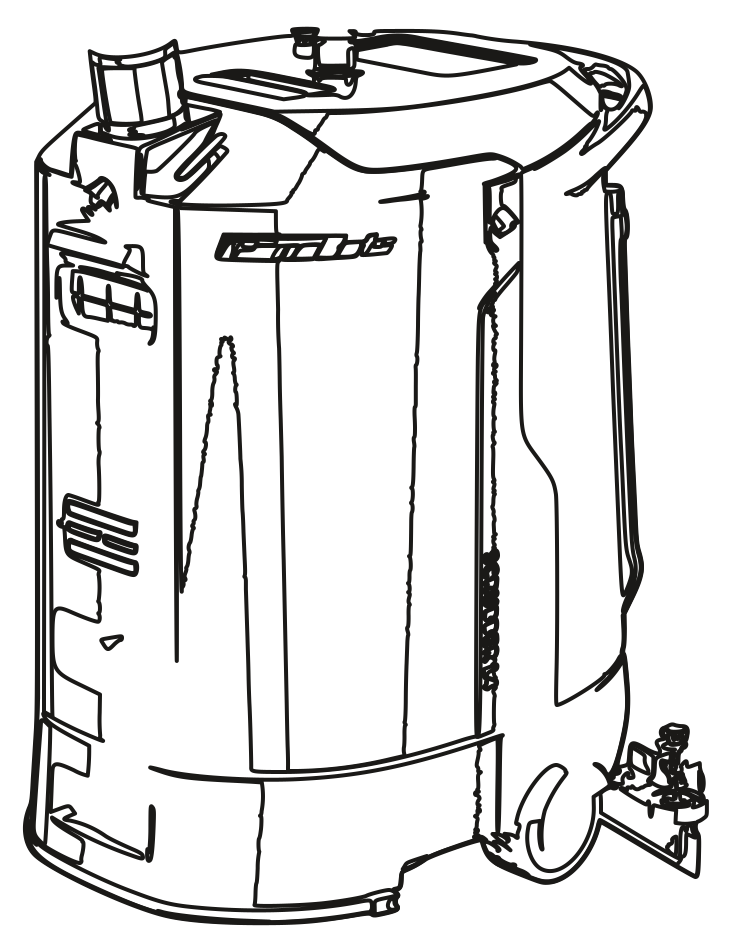
The school corridor is the strongest robot case in the entire building: long, straight, hard-floored, wide, and completely empty once the last group has left. That is precisely what a compact scrubber-dryer is built for. The Pudu CC1 works at 500 mm cleaning width including the side brush, 700–1,000 m²/h, 15-litre fresh and waste water tanks and an operating noise of under 70 dB(A) per its official manual. The number that decides whether it fits your building is a different one: minimum passage width 70 cm — and the same manual recommends at least 75 cm for long passages, so the machine can run them smoothly.

For wide corridors, entrance halls and assembly halls the two CenoBots scrubbers are the larger tools. The L4 has a 450 mm cleaning width, up to 1,944 m²/h theoretical productivity, a 38-litre solution tank, a minimum passable width of 810 mm and its actual headline feature: edge cleaning to less than 3 cm from the wall. The L3 is the narrower one at 400 mm width, up to 2,016 m²/h theoretical, a 25-litre solution tank and a 700 mm minimum passage. Both productivity figures are explicitly theoretical maxima on the manufacturer's own pages — real-world throughput is lower, and anyone quoting them as a promise is quoting them wrong. Worth noting for this vertical: CenoBots lists schools and educational facilities among the official target segments for both machines, and Pudu lists Education among the usage scenarios for the CC1 series.

Edge cleaning deserves the emphasis it rarely gets, because a school corridor is mostly edges: lockers, coat hooks, skirting boards, door recesses. A machine that leaves a visible dirt line 10 cm from the wall creates manual follow-up work every single day, which is where the time saving quietly disappears. Which class of machine fits which floor at all is the subject of our scrubber-dryer guide.

A covered break area or an open school atrium is not an indoor floor, and it needs a dry machine. The Pudu MT1 Max is a dry sweeper — completely waterless — with IP54 protection, a 70 cm sweeping width and a 35-litre debris bin; Pudu's official launch release positions it for underground car parks and semi-open building atriums. What it can and cannot do outdoors is covered in our piece on outdoor sweeping robots. And the honest counter-list for the inside of the building: sanitary areas, stairs, desks, door handles, window sills and everything under furniture stay manual, in every school, with every machine.

CC1
L4
L3
CC170 cm minimum passageL4edge cleaning < 3 cmL3700 mm passage
Pictograms: vectorized 1:1 from our product reference photos — not illustrative icons.
03

Classrooms: obstacle density decides everything

A classroom with the chairs up on the desks is not an open floor. It is a grid — rows of table legs with narrow lanes between them, and that geometry, not the machine's cleaning power, decides what happens. The relevant specification is the minimum passable width: 70 cm for the CC1 (with at least 75 cm recommended for long runs), 700 mm for the L3, 810 mm for the L4. Measure the lane between two rows of desks in your own classrooms before anyone promises you autonomous classroom cleaning; in many school buildings that lane is narrower than the machine needs.

The honest consequence is a partial answer. A robot drives the lanes and the free areas at the front and back of the room; the strip under the desks and around the table legs stays manual. And if the chairs are not up, the room cannot be machine-cleaned at all — that is an organisational precondition, not a machine question, and it is worth settling with the teaching staff before the first deployment rather than after it. How machines build their map of a room in the first place, and why a room that changes every afternoon is harder than a corridor, is the subject of our piece on navigation in cleaning robots.

That is why the sensible order in a school is corridors first, classrooms later and partially. It is also why the general decision framework — which cleaning robot fits which operation — lands differently here than in retail: in a supermarket the sales floor is the area that matters; in a school it is the corridor.

The administrative wing is its own small case. Staff rooms, the school office and meeting rooms are small areas, often carpeted, and a large scrubber has no business there. The Nexaro NR 1700 is a dry vacuum robot rated at max. 100 m²/h with 250 minutes of runtime in Eco mode per its official datasheet — small-area equipment by design, not a hall machine. It is also the machine that makes the next section short.

04

Sports halls: the floor first, then the machine

The gym floor is the most sensitive surface in the building, and it is the one place in a school where we slow down instead of speeding up. Sports flooring means sealed parquet, elastic coverings, and area- or point-elastic constructions with a substructure. The cleaning instructions for those come from the floor manufacturer, not from the machine manufacturer — and where those two disagree, the floor wins, because the floor is the asset the municipality owns. Our sports halls page describes how we approach a hall; this section describes why the approach starts with paperwork.

Here is the verified fact that changes the conversation. The official Pudu CC1 operation guide states the application scope as terrazzo, marble, tiles, epoxy resin, sandstone, artificial stone and low-pile carpet. Parquet, linoleum, PVC and elastic sports surfaces are not on that list. That does not mean the machine would destroy them — it means the manufacturer does not clear them, and on a municipally owned hall floor that distinction is the one that matters. The same applies to the CC1 Pro, whose additional value in a school lies elsewhere entirely, as our CC1 versus CC1 Pro comparison sets out.

One machine in our fleet reads differently. The official Pudu SH1 datasheet lists the suitable floor materials as tile, terrazzo, granite, marble, epoxy finish and hardwood flooring — wood is explicitly in the manufacturer's list, which it is not for the CC1. The SH1 is a walk-behind machine and always runs with an operator, never autonomously: 44 cm working width, 4-litre tanks, 70 minutes of runtime in standard and 100 minutes in ECO mode. On noise, Pudu's own sources disagree — the official datasheet states 76 dB(A) standard and 71 dB(A) ECO, the official product page 72 and 69 dB(A) — so we quote the higher pair and treat it as a daytime-capable machine, not a quiet one. For a full hall surface that is not an area tool. But be precise about what the clearance covers: a listing for "hardwood flooring" is not a clearance for a floating, point-elastic sports floor with a sprung substructure. That one still comes from the floor manufacturer.

Two more things from our deployment matrix, honestly labelled. First, weight: on floating and point-elastic sports floors, point load is a real constraint, which is why heavy machines such as the Pudu BG1 (344 kg) or the Adlatus SR1300 (485 kg) do not appear in our sports-hall column at all — see our market overviews of the BG1 and the SR1300. Second, the one machine whose manufacturer names sport halls as an official field of application is the Adlatus CR700D, which is available through us but newly onboarded; our assessment of it is documentation-based. Its official brochure of September 2025 lists "industrial areas, shopping arcades, sports halls, office buildings, public facilities, car parks" as fields of application, and describes a 330 mm disc-brush or pad deck where "pads enable gentle yet effective floor care". Note the fine print we will not blur: the floor types the same brochure names are tiles, concrete, PVC and natural stone. Sport halls as an application field and parquet as a cleared surface are two different statements. The machine itself is covered in our CR700 market overview.

05

Cameras in a building full of children

In a school this question arrives earlier than in an office, and it arrives from someone whose job is to ask it. Recital 38 of the GDPR states: "Children merit specific protection with regard to their personal data, as they may be less aware of the risks, consequences and safeguards concerned and their rights in relation to the processing of personal data." That is not a rule about cleaning robots. It is the posture with which a school authority looks at any device carrying sensors, and it is why the sign-off in a school takes a form it does not take in a warehouse. We do not give legal advice; the assessment of a specific deployment belongs to the school authority's data protection officer.

The technical picture, stated plainly and without drama. The CC1 navigates with a sensor suite that includes cameras alongside its lidar; on the CC1 Pro, Pudu's own official product deck labels a front AI RGB camera and a rear AI RGB sensor in the component diagram. The Nexaro NR 1700, by contrast, lists its sensors in the official datasheet as a long-range laser distance sensor (LR-LDS), a bumper sensor, eight drop sensors and further sensors — no imaging device appears in that list. We run both types of machine and we say which is which, because a procurement conversation that starts with an evasion ends badly.

Now the part that should not get lost: a camera on a cleaning robot is not a surveillance camera. None of these manufacturers advertises a recording function; the cameras exist so the machine does not drive into a schoolbag. The questions that actually need answering are narrower and more useful: are images stored at all, do they ever leave the machine — including for remote diagnostics or as training data — where do the map and the telemetry sit, and who is allowed to read them. Our article on cleaning robots and GDPR works through them document by document, including for our own fleet.

The practical consequence for a municipal client is simple. If you want the sign-off to be fast, put the machine with the short answer into the sensitive areas. How explicit manufacturers have become on this is visible in the Adlatus CR700D brochure, which states "No personal or environment-related data is collected" and that the robots work "without Wi-Fi or a constant internet connection" — quoted here as documentation, not as a recommendation.

06

Holiday blocks, evidence, and what actually drives the cost

The school year gives autonomous cleaning something no other vertical offers: several weeks a year in which the building is genuinely empty. That is where deep cleaning sits, and it is where a machine changes the arithmetic most — it can run long, repeated, unattended passes at hours when a human shift would be expensive or simply unavailable. During term time the pattern reverses into short daily maintenance runs in the window after the last group leaves. Neither pattern needs the machine to be silent, because unlike a hotel there is nobody sleeping in the building; how we schedule unattended runs and what has to be true before one starts is covered in our piece on night operation.

Public clients want evidence, and this is the point where robots deliver something a mop cannot. Cleaning services for schools are generally awarded in competition, with the required services fixed in a specification — and whether they were delivered is, in daily practice, a matter of spot checks and complaints. Autonomous machines log area, time and route as a by-product of operating. Some go further: per Pudu's official product deck the CC1 Pro's rear AI camera "monitors and evaluates cleaning performance in real-time", detects leftover stains, triggers spot re-cleaning and generates heatmaps after each task, with a cleaning-performance heatmap that marks stains still present after several cycles. Adlatus describes for the CR700D a "fully automated, certified and data protection-compliant logging" after each use, covering cleaned areas and time spent for invoicing, performance records and audits. What such records are worth in a tender, and what they are not, is the subject of our article on cleaning verification.

On cost we give factors, not figures — anyone quoting you a price per square metre for schools without seeing the building is guessing. What actually drives it: total area and the mix of floor coverings; cleaning frequency per room type; the share of sanitary area, which is fully manual and the most labour-intensive part; the time window and how late it sits; sports halls with weekend club use, which adds cleaning slots outside the school's own rhythm; the holiday deep-clean block; and one factor that is regularly forgotten in the calculation — whether the area is machine-accessible at all. A classroom with chairs left down is manual area, whatever the contract says. Our cost article works through the same logic for robots specifically.

And the honest limit. A robot does not replace a cleaner in a school. It takes over the largest, most monotonous, most repeatable part of the area — corridors, halls, canteen floor — and gives the team back the time for the parts that actually need a person: sanitary areas, surfaces, edges, and the problem nobody planned for that morning.

07

Frequent questions

Partly. Corridors, halls and canteens can be cleaned while lessons run behind closed doors, and the machines are built for shared space: they detect people, slow down or stop, and move at walking pace or below. In practice the main run still belongs in the window after the last group leaves, because a corridor with two hundred pupils in it is not a cleanable corridor. Classrooms are the exception in the other direction — they can only be cleaned when they are empty and the chairs are up on the desks.

Both models are common and it varies by school authority. Some municipalities clean in-house with caretakers and their own staff; others award the service to a building-services contractor, usually through a tender. We publish no split between the two because we have no figure we could verify. Operationally the difference is smaller than it looks: the window, the area and the thin staffing are the same either way, and so is the pressure to document what was actually delivered.

Only after the floor has been checked, and the check comes before the machine choice. The official Pudu CC1 operation guide names terrazzo, marble, tiles, epoxy resin, sandstone, artificial stone and low-pile carpet as its application scope — parquet and elastic sports surfaces are not listed. The Pudu SH1 datasheet does list hardwood flooring, but the SH1 is a walk-behind machine that always runs with an operator, and a hardwood listing is still not a clearance for a sprung, point-elastic sports floor. That clearance comes from the floor manufacturer, and we ask for it before anything wet touches a hall floor.

We publish no prices, and any figure quoted without seeing the building is a guess. The drivers are: total area and the mix of floor coverings; cleaning frequency per room type; the share of sanitary area, which is fully manual and the most labour-intensive part of the job; how late the cleaning window sits and whether the building has to be opened or supervised for it; sports halls with weekend club use; the holiday deep-clean block; and whether the area is machine-accessible at all. That last one is regularly missing from calculations and quietly decides how much of the building a robot can actually take over.

That assessment belongs to the school authority's data protection officer, and we do not make it. What we can supply is the technical basis. Recital 38 of the GDPR states that children merit specific protection with regard to their personal data, which is why the question is asked earlier and more thoroughly in a school than elsewhere. Machines differ: the Pudu CC1 and CC1 Pro navigate with sensor suites that include cameras, while the Nexaro NR 1700 datasheet lists a laser distance sensor, bumper, drop sensors and further sensors with no imaging device. A camera on a cleaning robot is not a surveillance camera and none of these manufacturers advertises recording — but whether images are stored, whether they ever leave the machine, and where map and telemetry data sit should be answered in writing before an award.

See it instead of reading?

We show you the machines in 30 minutes at your site — free and non-binding.

Request a demo
Pudu CC1View machine →CenoBots L4View machine →CenoBots L3View machine →Pudu SH1View machine →Nexaro NR1700View machine →